Mars
Mars is the fourth planet from the Sun and the seventh largest in the Solar System. A cold, dusty desert world with a thin atmosphere (mostly CO₂), the planet features extinct volcanoes, deep canyons, polar ice caps, and seasons. Mars has two small moons (Phobos and Deimos), a day just over 24 hours long, and a year lasting about 687 Earth days. It is a prime focus of robotic exploration and studies about past water and habitability.
Source: science.nasa.gov
APODs including "Mars"
Night in the Andes Ice Forest
07/09/2013
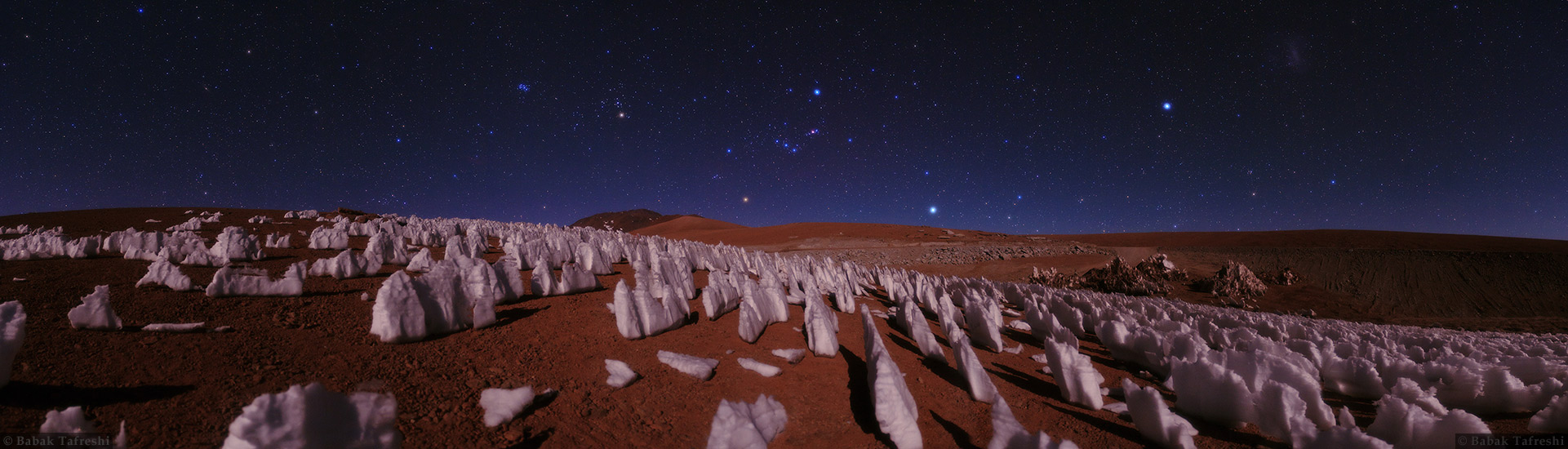
This forest of snow and ice penitentes reflects moonlight shining across the Chajnantor plateau. The region lies in the Chilean Andes at an altitude of 5,000 meters, not far from one of planet Earth's major astronomical observatories, the Atacama Large Millimeter/submillimeter Array. Up to several meters high, the flattened, sharp-edged shapes, and orientation of the penitentes tend to minimize their shadows at local noon. In the dry, cold, thin atmosphere, sublimation driven by sunlight is important for their formation. A direct transition from a solid to a gaseous state, sublimation shapes other solar system terrains too, like icy surfaces of comets and the polar caps of Mars. Above the dreamlike landscape stretches the southern night sky. Their own forms rooted in myth, look for the constellations Pegasus, Andromeda, and Perseus near the panorama's left edge. Bright and colorful stars of Orion the Hunter are near center, with the Large Magellanic Cloud and the South Celestial Pole on the far right.