Mars
Mars is the fourth planet from the Sun and the seventh largest in the Solar System. A cold, dusty desert world with a thin atmosphere (mostly CO₂), the planet features extinct volcanoes, deep canyons, polar ice caps, and seasons. Mars has two small moons (Phobos and Deimos), a day just over 24 hours long, and a year lasting about 687 Earth days. It is a prime focus of robotic exploration and studies about past water and habitability.
Source: science.nasa.gov
APODs including "Mars"
Martian Sunset
02/03/2014
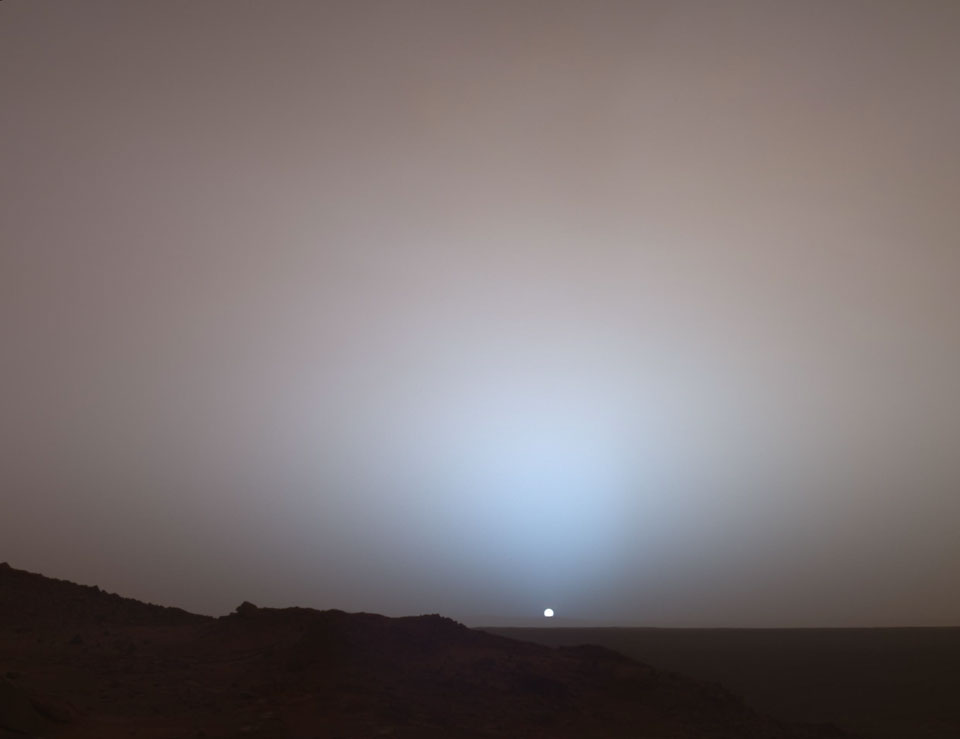
What would it be like to see a sunset on Mars? To help find out, the robotic rover Spirit was deployed in 2005 to park and watch the Sun dip serenely below the distant lip of Gusev crater. Colors in the above image have been slightly exaggerated but would likely be apparent to a human explorer's eye. Fine martian dust particles suspended in the thin atmosphere lend the sky a reddish color, but the dust also scatters blue light in the forward direction, creating a bluish sky glow near the setting Sun. Because Mars is farther away, the Sun is less bright and only about two thirds the diameter it appears from Earth. Images like this help atmospheric scientists understand not only the atmosphere of Mars, but atmospheres across the Solar System, including our home Earth.