Mars
Mars is the fourth planet from the Sun and the seventh largest in the Solar System. A cold, dusty desert world with a thin atmosphere (mostly CO₂), the planet features extinct volcanoes, deep canyons, polar ice caps, and seasons. Mars has two small moons (Phobos and Deimos), a day just over 24 hours long, and a year lasting about 687 Earth days. It is a prime focus of robotic exploration and studies about past water and habitability.
Source: science.nasa.gov
APODs including "Mars"
Mars Red and Spica Blue
02/04/2014
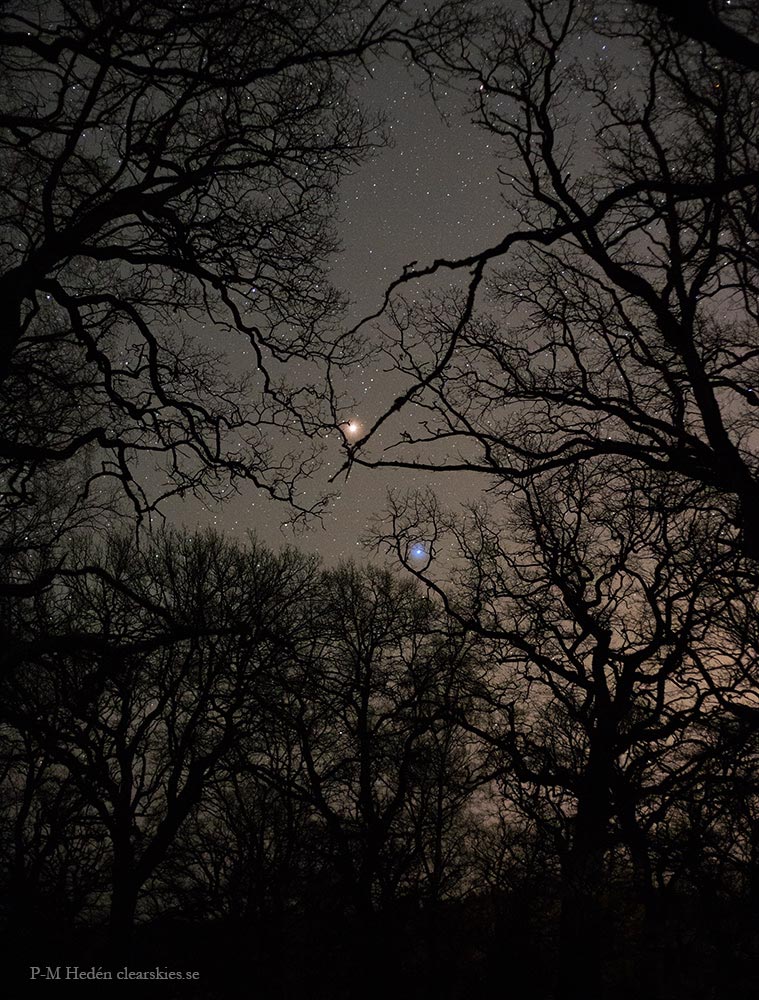
A bright pair of sky objects will be visible together during the next few months. Mars will shine brightly in its familiar rusty hue as it reaches its brightest of 2014 next week. The reason that Mars appears so bright is that Earth and Mars are close to each other in their long orbits around the Sun. Spica, on the other hand, shines constantly as one of the brightest blue stars in the night sky. Pronounced "spy-kah", the blue-hued star has been visible throughout human history and the sounds that identify it today date back to ancient times. Pictured above, the planet and the star were photographed rising together toward the southeast after sunset last week through old oak trees in Sweden. Click Hyperspace: Random APOD Generator