Mars
Mars is the fourth planet from the Sun and the seventh largest in the Solar System. A cold, dusty desert world with a thin atmosphere (mostly CO₂), the planet features extinct volcanoes, deep canyons, polar ice caps, and seasons. Mars has two small moons (Phobos and Deimos), a day just over 24 hours long, and a year lasting about 687 Earth days. It is a prime focus of robotic exploration and studies about past water and habitability.
Source: science.nasa.gov
APODs including "Mars"
Rosetta's Rendezvous
07/08/2014
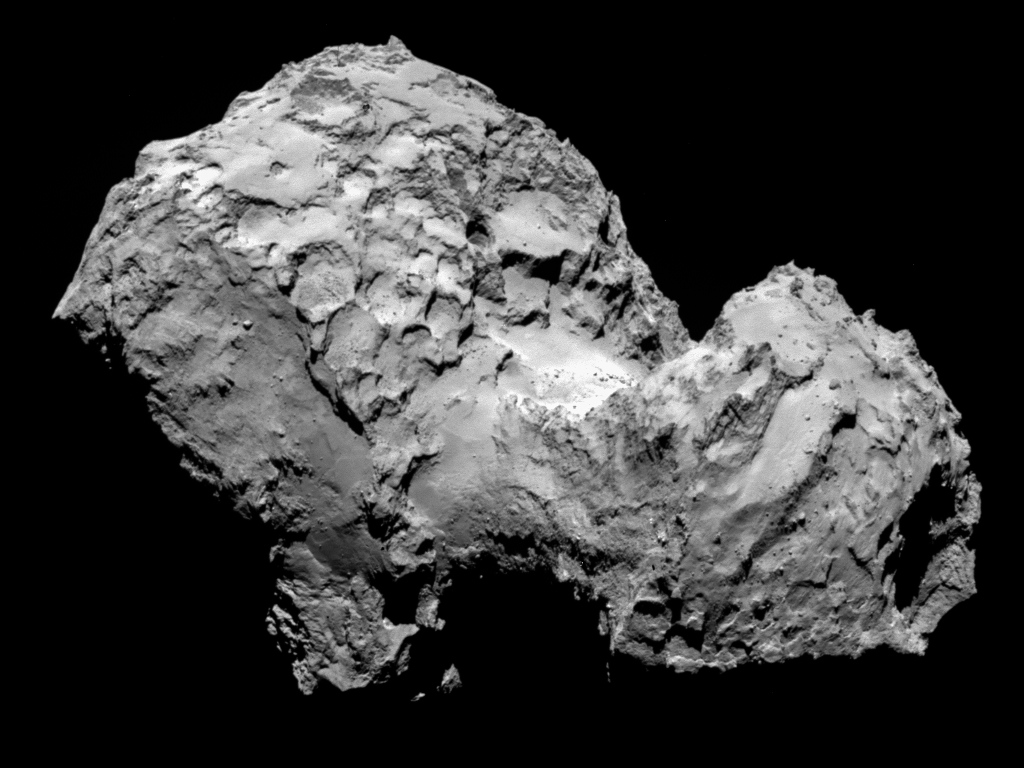
On August 3rd, the Rosetta spacecraft's narrow angle camera captured this stunning image of the nucleus of Comet 67P/Churyumov-Gerasimenko. After 10 years and 6.5 billion kilometers of travel along gravity assist trajectories looping through interplanetary space, Rosetta had approached to within 285 kilometers of its target. The curious double-lobed shape of the nucleus is revealed in amazing detail at an image resolution of 5.3 meters per pixel. About 4 kilometers across, the comet nucleus is presently just over 400 million kilometers from Earth, between the orbits of Jupiter and Mars. Now the first spacecraft to achieve a delicate orbit around a comet, Rosetta will swing to within 50 kilometers and closer in the coming weeks, identifiying candidate sites for landing its probe Philae later this year.