Mars
Mars is the fourth planet from the Sun and the seventh largest in the Solar System. A cold, dusty desert world with a thin atmosphere (mostly CO₂), the planet features extinct volcanoes, deep canyons, polar ice caps, and seasons. Mars has two small moons (Phobos and Deimos), a day just over 24 hours long, and a year lasting about 687 Earth days. It is a prime focus of robotic exploration and studies about past water and habitability.
Source: science.nasa.gov
APODs including "Mars"
Messier 6 and Comet Siding Spring
17/10/2014
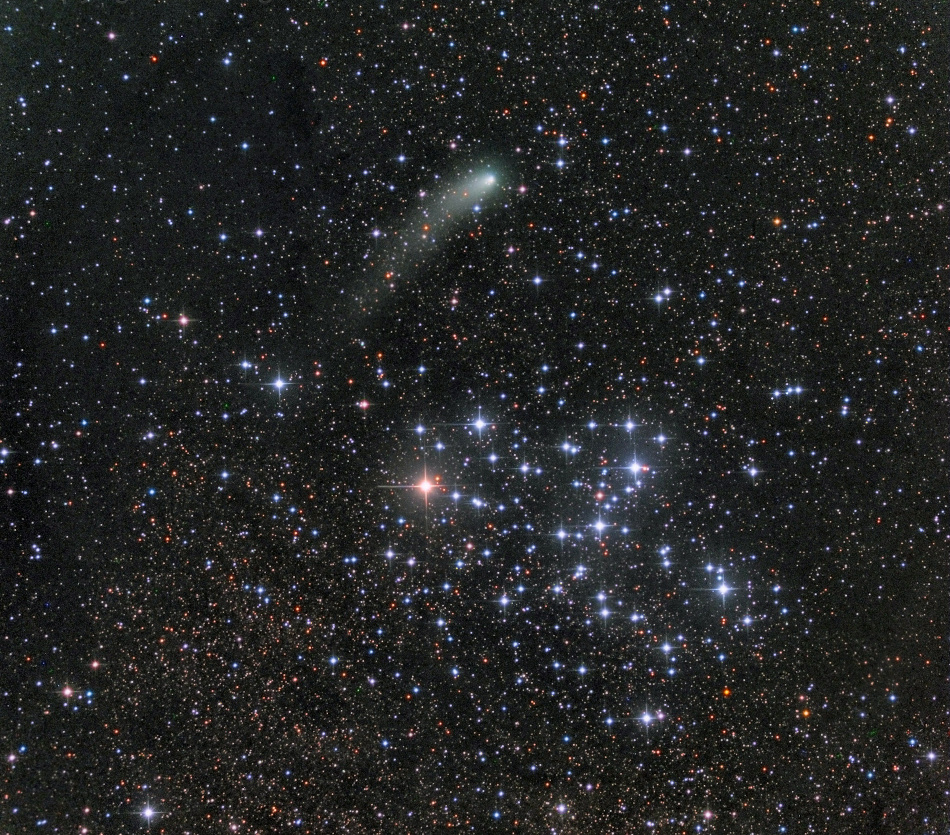
This looks like a near miss but the greenish coma and tail of Comet Siding Spring (C/2013 A1) are really 2,000 light-years or so away from the stars of open cluster Messier 6. They do appear close together though, along the same line-of-sight in this gorgeous October 9th skyscape toward the constellation Scorpius. Still, on Sunday, October 19th this comet really will be involved in a near miss, passing within only 139,500 kilometers of planet Mars. That's about 10 times closer than any known comet flyby of planet Earth, and nearly one third the Earth-Moon distance. While an impact with the nucleus is not a threat the comet's dust, moving with a speed of about 56 kilometers per second relative to the Red Planet, and outskirts of its gaseous coma could interact with the thin Martian atmosphere. Of course, the comet's close encounter will be followed intently by spacecraft in Martian orbit and rovers on the surface.