Mars
Mars is the fourth planet from the Sun and the seventh largest in the Solar System. A cold, dusty desert world with a thin atmosphere (mostly CO₂), the planet features extinct volcanoes, deep canyons, polar ice caps, and seasons. Mars has two small moons (Phobos and Deimos), a day just over 24 hours long, and a year lasting about 687 Earth days. It is a prime focus of robotic exploration and studies about past water and habitability.
Source: science.nasa.gov
APODs including "Mars"
Comet Siding Spring Passes Mars
20/10/2014
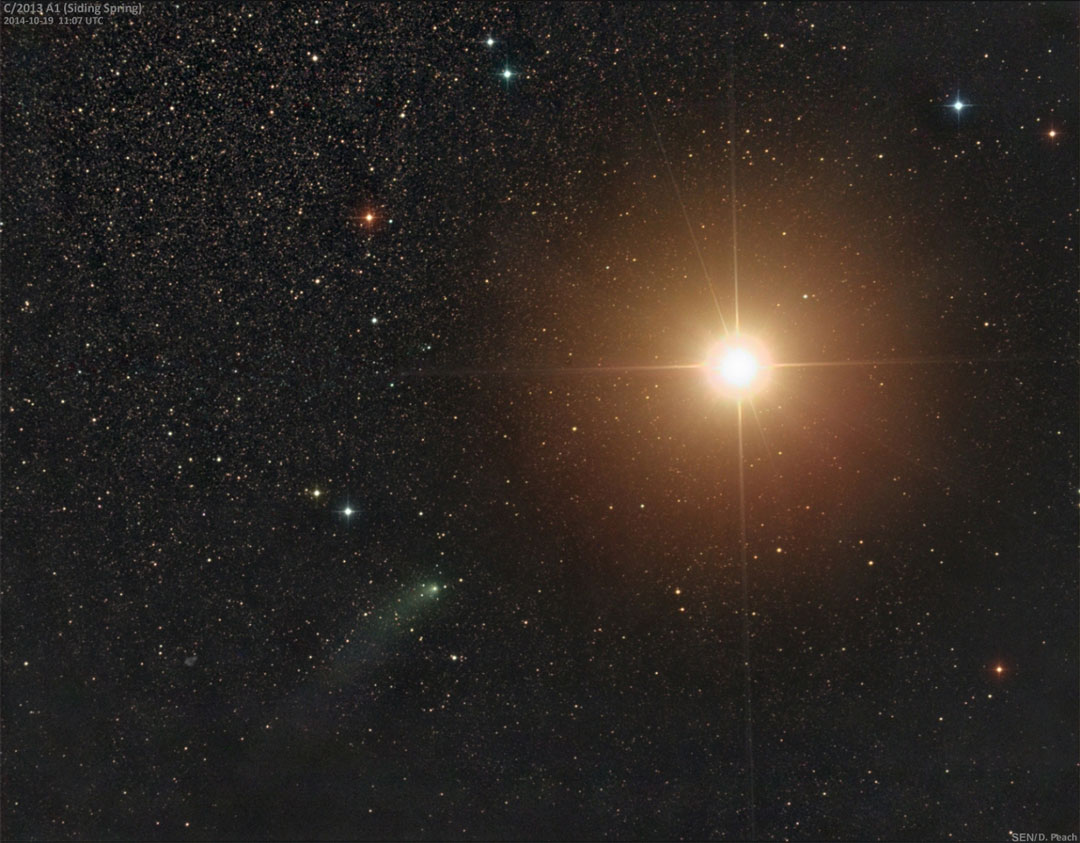
Yesterday, a comet passed very close to Mars. In fact, Comet C/2013 A1 (Siding Spring) passed closer to the red planet than any comet has ever passed to Earth in recorded history. To take advantage of this unique opportunity to study the close interaction of a comet and a planet, humanity currently has five active spacecraft orbiting Mars: NASA's MAVEN, MRO, Mars Odyssey, as well as ESA's Mars Express, and India's Mars Orbiter. Most of these spacecraft have now sent back information that they have not been damaged by small pieces of the passing comet. These spacecraft, as well as the two active rovers on the Martian surface -- NASA's Opportunity and Curiosity -- have taken data and images that will be downloaded to Earth for weeks to come and likely studied for years to come. The featured image taken yesterday, however, was not taken from Mars but from Earth and shows Comet Siding Spring on the lower left as it passed Mars, on the upper right. NASA Updates : Comet Siding Spring from Mars