Mars
Mars is the fourth planet from the Sun and the seventh largest in the Solar System. A cold, dusty desert world with a thin atmosphere (mostly CO₂), the planet features extinct volcanoes, deep canyons, polar ice caps, and seasons. Mars has two small moons (Phobos and Deimos), a day just over 24 hours long, and a year lasting about 687 Earth days. It is a prime focus of robotic exploration and studies about past water and habitability.
Source: science.nasa.gov
APODs including "Mars"
Charon and the Small Moons of Pluto
26/10/2015
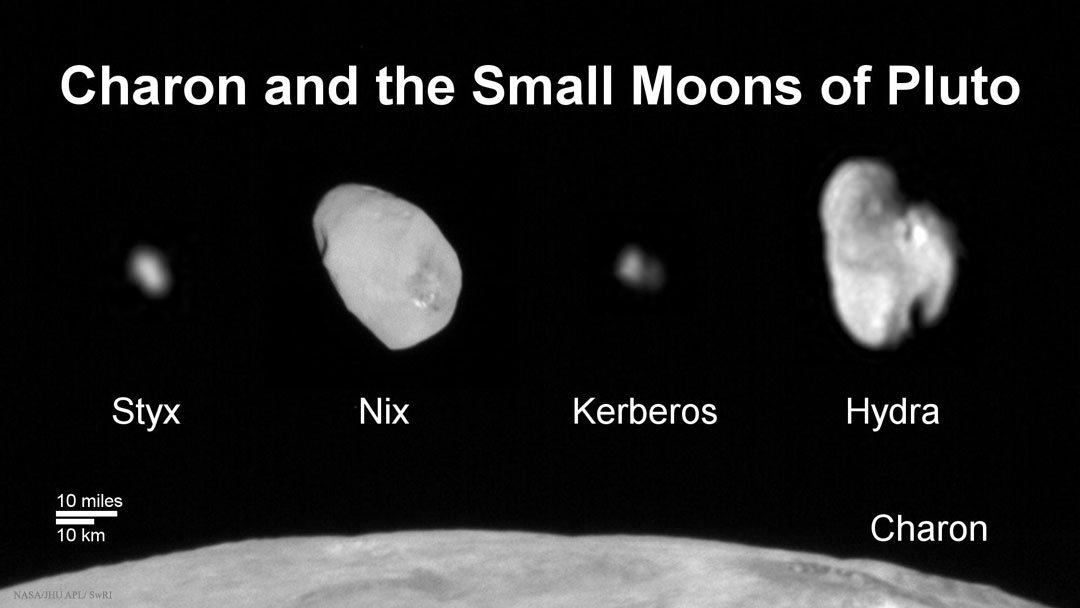
What do the moons of Pluto look like? Before a decade ago, only the largest moon Charon was known, but never imaged. As the robotic New Horizons spacecraft was prepared and launched, other moons were identified on Hubble images but remained only specks of light. Finally, this past summer, New Horizons swept right past Pluto, photographed Pluto and Charon in detail, and took the best images of Styx, Nix, Kerberos, and Hydra that it could. The featured image composite shows the results -- each moon is seen to have a distinct shape, while underlying complexity is only hinted. Even though not satisfyingly resolved, these images are likely to be the best available to humanity for some time. This is because the moons are too small and distant for contemporary Earth-based telescopes to resolve, and no new missions to the Pluto system are planned. Gallery: October's Venus, Jupiter, & Mars Conjunction