Mars
Mars is the fourth planet from the Sun and the seventh largest in the Solar System. A cold, dusty desert world with a thin atmosphere (mostly CO₂), the planet features extinct volcanoes, deep canyons, polar ice caps, and seasons. Mars has two small moons (Phobos and Deimos), a day just over 24 hours long, and a year lasting about 687 Earth days. It is a prime focus of robotic exploration and studies about past water and habitability.
Source: science.nasa.gov
APODs including "Mars"
Close Comet and the Milky Way
25/03/2016
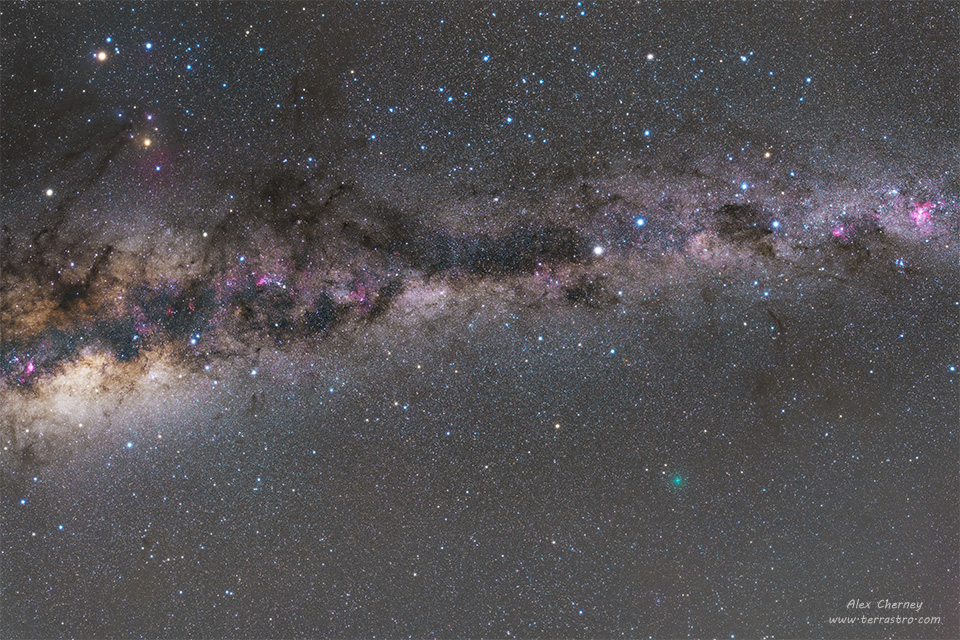
Comet 252P/Linear's lovely greenish coma is easy to spot in this expansive southern skyscape. Visible to the naked eye from the dark site near Flinders, Victoria, Australia, the comet appears tailless. Still, its surprisingly bright coma spans about 1 degree, posed here below the nebulae, stars, and dark rifts of the Milky Way. The five panels used in the wide-field mosaic were captured after moonset and before morning twilight on March 21. That was less than 24 hours from the comet's closest approach, a mere 5.3 million kilometers from our fair planet. Sweeping quickly across the sky because it is so close to Earth, the comet should be spotted in the coming days by northern hemisphere comet watchers. In predawn but moonlit skies it will move through Sagittarius and Scorpius seen toward the southern horizon. That's near the triangle formed by bright, yellowish, Mars, Saturn, and Antares at the upper left of this frame.