Mars
Mars is the fourth planet from the Sun and the seventh largest in the Solar System. A cold, dusty desert world with a thin atmosphere (mostly CO₂), the planet features extinct volcanoes, deep canyons, polar ice caps, and seasons. Mars has two small moons (Phobos and Deimos), a day just over 24 hours long, and a year lasting about 687 Earth days. It is a prime focus of robotic exploration and studies about past water and habitability.
Source: science.nasa.gov
APODs including "Mars"
Saturn and Mars visit Milky Way Star Clouds
10/05/2016
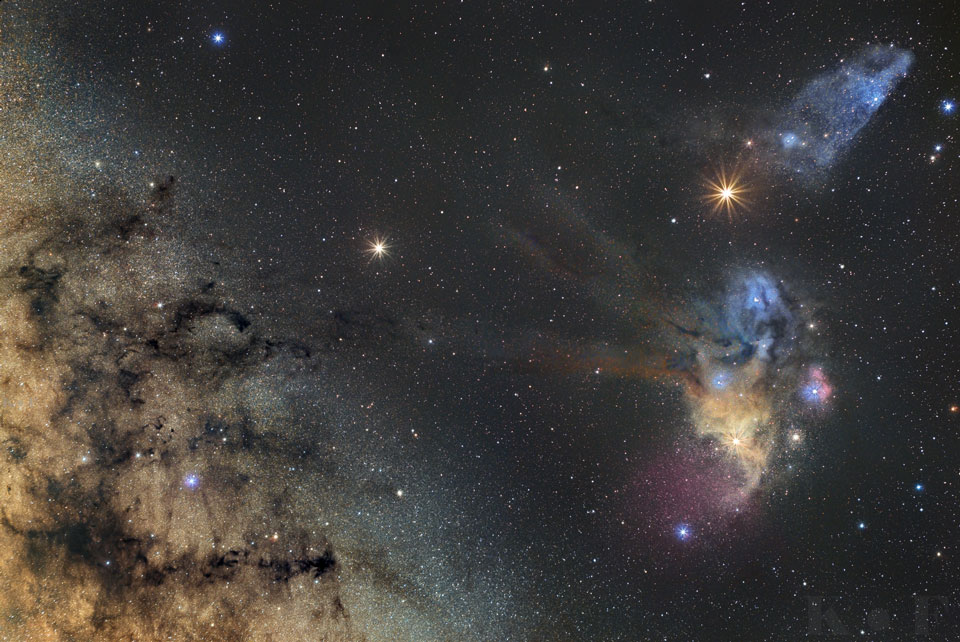
Planets, stars, nebulas and a galaxy -- this impressive image has them all. Closest to home are the two planets Mars (right) and Saturn (center), visible as the two bright orange spots in the upper half of the featured image. On the central right are the colorful Rho Ophiuchus star clouds featuring the bright orange star Antares lined up below Mars. These interstellar clouds contain both red emission nebulas and blue reflection nebulas. At the top right of the image is the Blue Horsehead reflection nebula. On the lower left are many dark absorption nebulas that extend from the central band of our Milky Way Galaxy. The featured deep composite was composed of multiple deep exposures taken last month from Brazil. Although you need a telescope to see the nebulosities, Saturn and Mars will remain visible to the unaided eye this month toward the east, just after sunset. Follow APOD on: Facebook, Google Plus, Instagram, or Twitter