Mars
Mars is the fourth planet from the Sun and the seventh largest in the Solar System. A cold, dusty desert world with a thin atmosphere (mostly CO₂), the planet features extinct volcanoes, deep canyons, polar ice caps, and seasons. Mars has two small moons (Phobos and Deimos), a day just over 24 hours long, and a year lasting about 687 Earth days. It is a prime focus of robotic exploration and studies about past water and habitability.
Source: science.nasa.gov
APODs including "Mars"
Summer Planets and Milky Way
23/07/2016
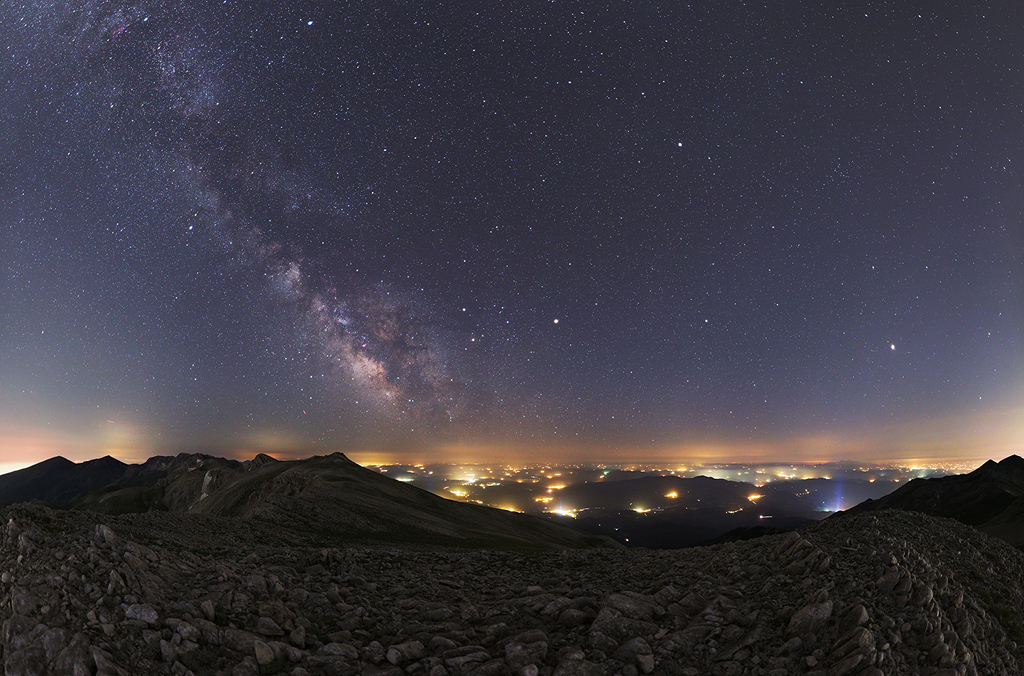
Lights sprawl toward the horizon in this night skyscape from Uludag National Park, Bursa Province, Turkey, planet Earth. The stars and nebulae of the Milky Way are still visible though, stretching above the lights on the northern summer night while three other planets shine brightly. Jupiter is at the far right, Mars near the center of the frame, and Saturn is just right of the bulging center of our galaxy. Because the panoramic scene was captured on July 6, all three planets pictured were hosting orbiting, operational, robotic spacecraft from Earth. Popular Mars has five (from three different space agencies): MAVEN (NASA), Mars Orbiter Mission (India), Mars Express (ESA), Mars Odyssey (NASA), Mars Reconnaissance Orbiter (NASA). Ringed Saturn hosts the daring Cassini spacecraft. Just arrived, Juno now orbits ruling gas giant Jupiter.