Mars
Mars is the fourth planet from the Sun and the seventh largest in the Solar System. A cold, dusty desert world with a thin atmosphere (mostly CO₂), the planet features extinct volcanoes, deep canyons, polar ice caps, and seasons. Mars has two small moons (Phobos and Deimos), a day just over 24 hours long, and a year lasting about 687 Earth days. It is a prime focus of robotic exploration and studies about past water and habitability.
Source: science.nasa.gov
APODs including "Mars"
The Milky Way Sets
26/08/2016
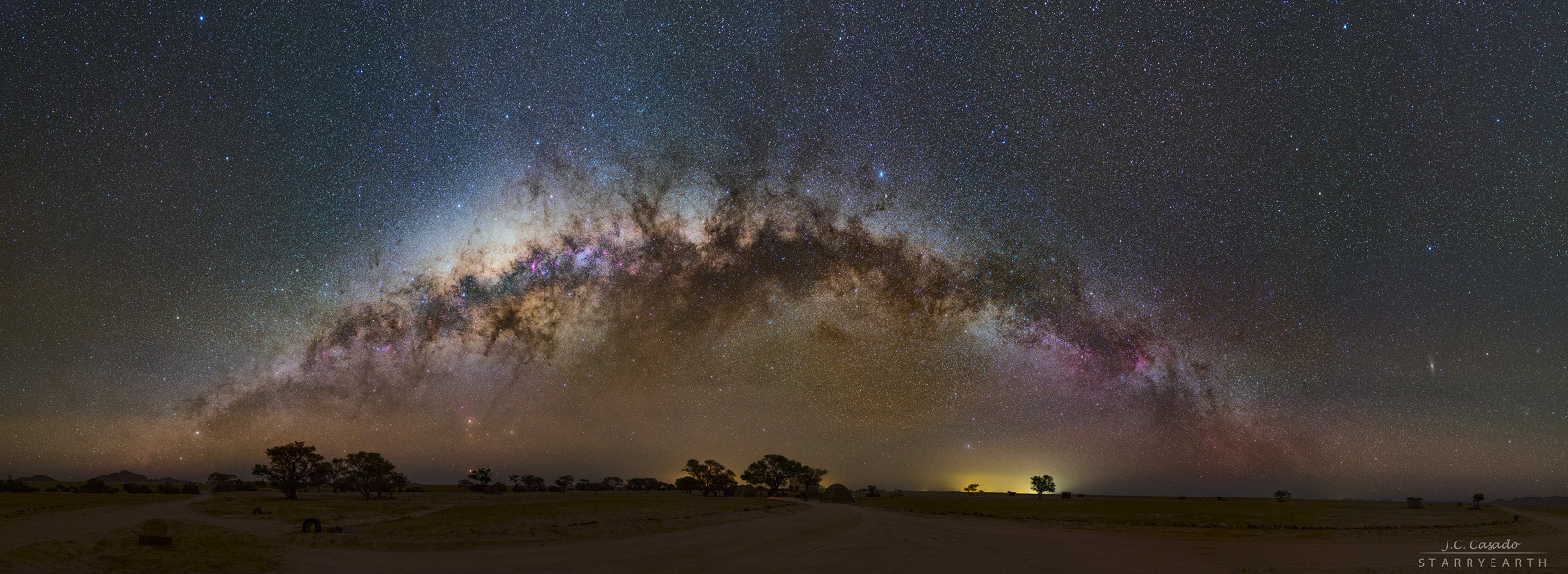
Under dark skies the setting of the Milky Way can be a dramatic sight. Stretching nearly parallel to the horizon, this rich, edge-on vista of our galaxy above the dusty Namibian desert stretches from bright, southern Centaurus (left) to Cepheus in the north (right). From early August, the digitally stitched, panoramic night skyscape captures the Milky Way's congeries of stars and rivers of cosmic dust, along with colors of nebulae not readily seen with the eye. Mars, Saturn, and Antares, visible even in more luminous night skies, form the the bright celestial triangle just touching the trees below the galaxy's central bulge. Of course, our own galaxy is not the only galaxy in the scene. Two other major members of our local group, the Andromeda Galaxy and the Triangulum Galaxy, lie near the right edge of the frame, beyond the arc of the setting Milky Way.