Mars
Mars is the fourth planet from the Sun and the seventh largest in the Solar System. A cold, dusty desert world with a thin atmosphere (mostly CO₂), the planet features extinct volcanoes, deep canyons, polar ice caps, and seasons. Mars has two small moons (Phobos and Deimos), a day just over 24 hours long, and a year lasting about 687 Earth days. It is a prime focus of robotic exploration and studies about past water and habitability.
Source: science.nasa.gov
APODs including "Mars"
When Mars met Neptune
13/01/2017
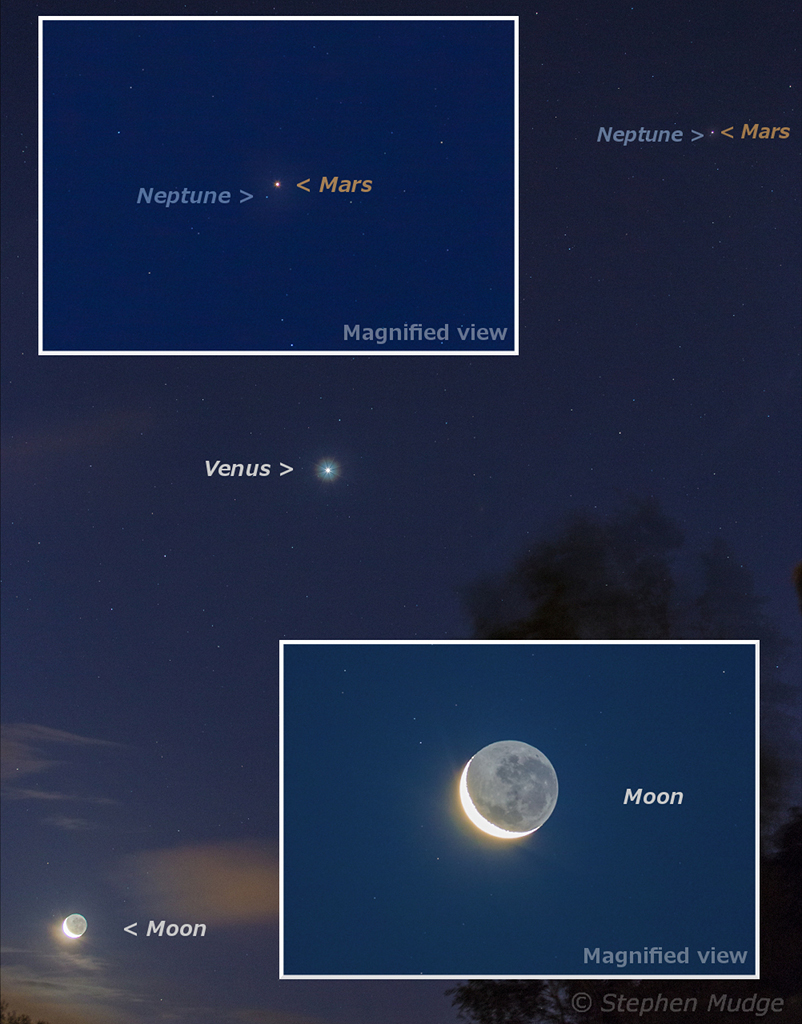
On January 1, a Mars-assisted viewing opportunity allowed binocular-equipped skygazers to cross an ice giant off their life list. Remarkably, the line-of-sight to the bright Red Planet could guide you to within 0.02 degrees of a faint, pale Neptune in Earth's night skies. Taken within 3 hours of their closest conjunction, these panels capture the odd couple's appearance in skies over Brisbane, Australia. A wide field view includes the new year's slender crescent moon near the western horizon and Venus as the brilliant evening star. Mars and Neptune are indicated at the upper right. The two inset magnified views were taken with the same telephoto lens and so do show the Mars-Neptune conjunction and the apparent size of the crescent moon at the same scale. This week Neptune hangs out near Venus on the western sky.