Mars
Mars is the fourth planet from the Sun and the seventh largest in the Solar System. A cold, dusty desert world with a thin atmosphere (mostly CO₂), the planet features extinct volcanoes, deep canyons, polar ice caps, and seasons. Mars has two small moons (Phobos and Deimos), a day just over 24 hours long, and a year lasting about 687 Earth days. It is a prime focus of robotic exploration and studies about past water and habitability.
Source: science.nasa.gov
APODs including "Mars"
All Planets Panorama
25/02/2017
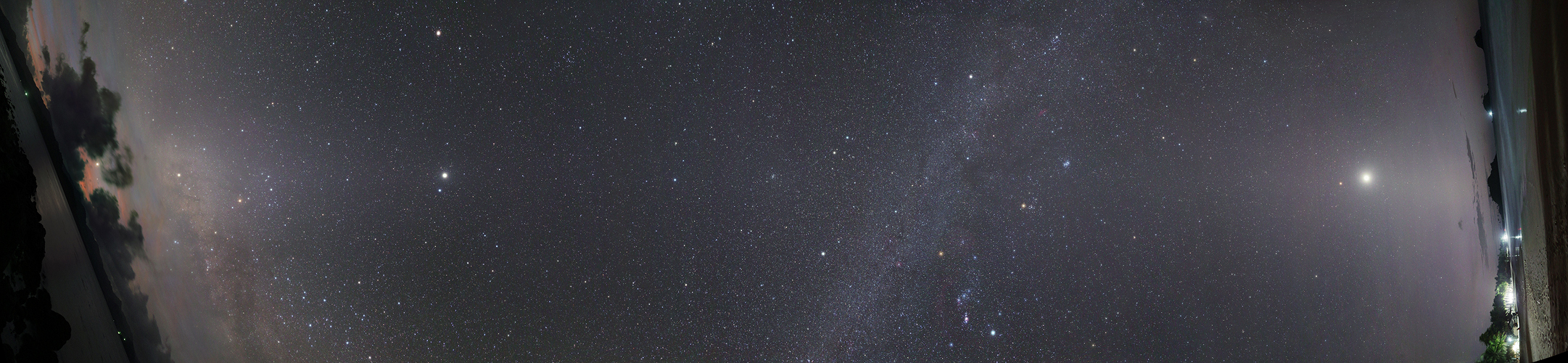
For 360 degrees, a view along the plane of the ecliptic is captured in this remarkable panorama, with seven planets in a starry sky. The mosaic was constructed using images taken during January 24-26, from Nacpan Beach, El Nido in Palawan, Philippines. It covers the eastern horizon (left) in dark early morning hours and the western horizon in evening skies. While the ecliptic runs along the middle traced by a faint band of zodiacal light, the Milky Way also cuts at angles through the frame. Clouds and the Moon join fleeting planet Mercury in the east. Yellowish Saturn, bright star Antares, and Jupiter lie near the ecliptic farther right. Hugging the ecliptic near center are Leo's alpha star Regulus and star cluster M44. The evening planets gathered along the ecliptic above the western horizon, are faint Uranus, ruddy Mars, brilliant Venus, and even fainter Neptune. A well labeled version of the panorama can be viewed by sliding your cursor over the picture, or just following this link.