Mars
Mars is the fourth planet from the Sun and the seventh largest in the Solar System. A cold, dusty desert world with a thin atmosphere (mostly CO₂), the planet features extinct volcanoes, deep canyons, polar ice caps, and seasons. Mars has two small moons (Phobos and Deimos), a day just over 24 hours long, and a year lasting about 687 Earth days. It is a prime focus of robotic exploration and studies about past water and habitability.
Source: science.nasa.gov
APODs including "Mars"
Moon, Mars, and Milky Way
11/08/2018
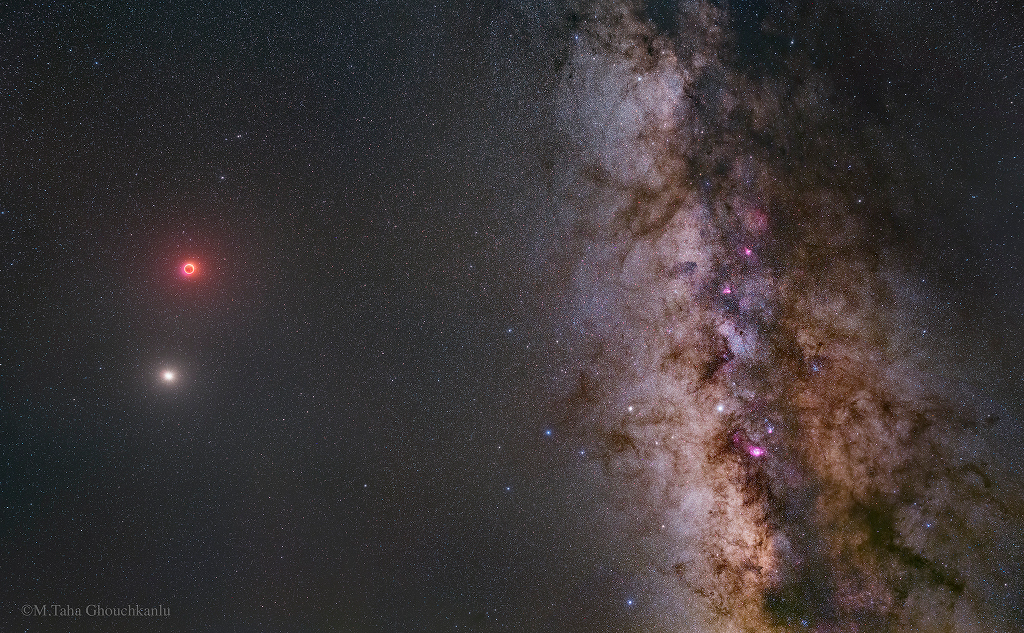
Just two weeks ago, dark skies over the desert in northern Iran held this alluring celestial vista. The dramatic digital mosaic finds the Moon and Mars alongside the Milky Way's dusty rifts, stars, and nebulae. Captured through a series of exposures to cover a range in brightness, that night's otherwise Full Moon is immersed in Earth's shadow. It actually appears fainter and redder than the Red Planet itself during the widely watched total lunar eclipse. For cosmic tourists, the skyscape also includes the Lagoon (M8) and Trifid (M20) nebulae and planet Saturn shining against the Milky Way's pale starlight. The Moon isn't quite done with its shadow play, though. Today, the New Moon partially eclipses the Sun for much of northern planet Earth.