Mars
Mars is the fourth planet from the Sun and the seventh largest in the Solar System. A cold, dusty desert world with a thin atmosphere (mostly CO₂), the planet features extinct volcanoes, deep canyons, polar ice caps, and seasons. Mars has two small moons (Phobos and Deimos), a day just over 24 hours long, and a year lasting about 687 Earth days. It is a prime focus of robotic exploration and studies about past water and habitability.
Source: science.nasa.gov
APODs including "Mars"
Ultraviolet Earth from an Observatory on the Moon
28/10/2018
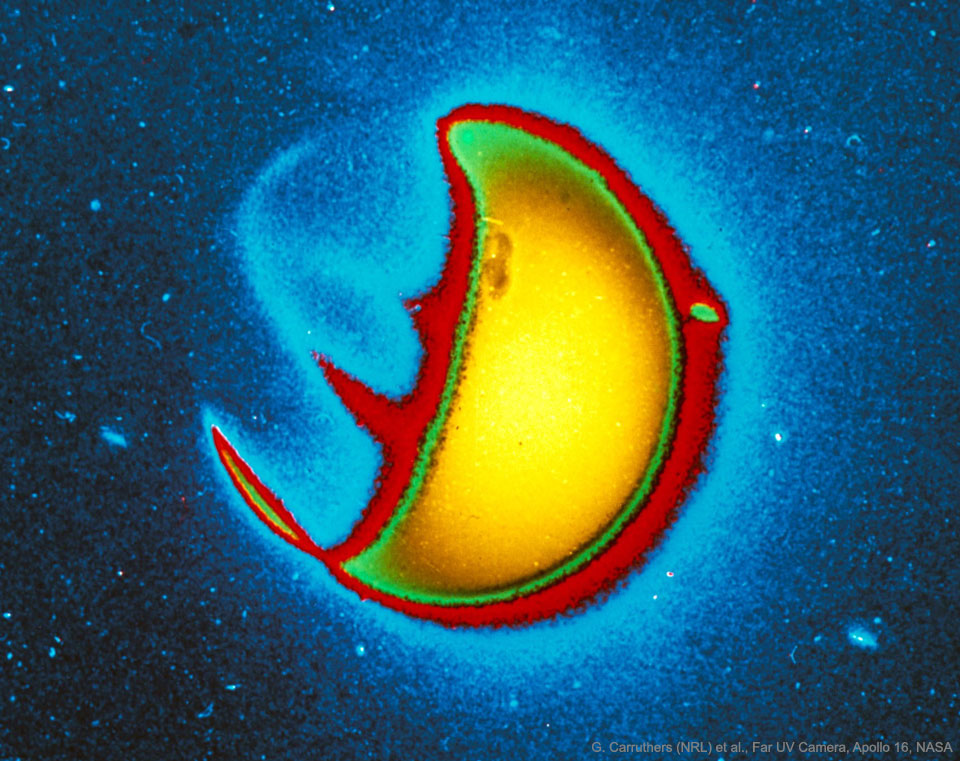
Which planet is this? Earth. The featured false color picture shows how the Earth shines in ultraviolet (UV) light. The image is historic because it was taken from the surface of the Moon by humanity's first lunar observatory. (Another is operating now.) Although very little UV light is transmitted through the Earth's atmosphere, what sunlight does make it through might cause a sunburn. The part of the Earth facing the Sun reflects much UV light, but perhaps more interesting is the side facing away from the Sun. Here bands of UV emission are the result of auroras and are caused by charged particles expelled by the Sun. Other planets showing auroras in the UV include Mars, Saturn, Jupiter, and Uranus.