Mars
Mars is the fourth planet from the Sun and the seventh largest in the Solar System. A cold, dusty desert world with a thin atmosphere (mostly CO₂), the planet features extinct volcanoes, deep canyons, polar ice caps, and seasons. Mars has two small moons (Phobos and Deimos), a day just over 24 hours long, and a year lasting about 687 Earth days. It is a prime focus of robotic exploration and studies about past water and habitability.
Source: science.nasa.gov
APODs including "Mars"
Curiosity Rover Finds a Clay Cache on Mars
29/10/2019
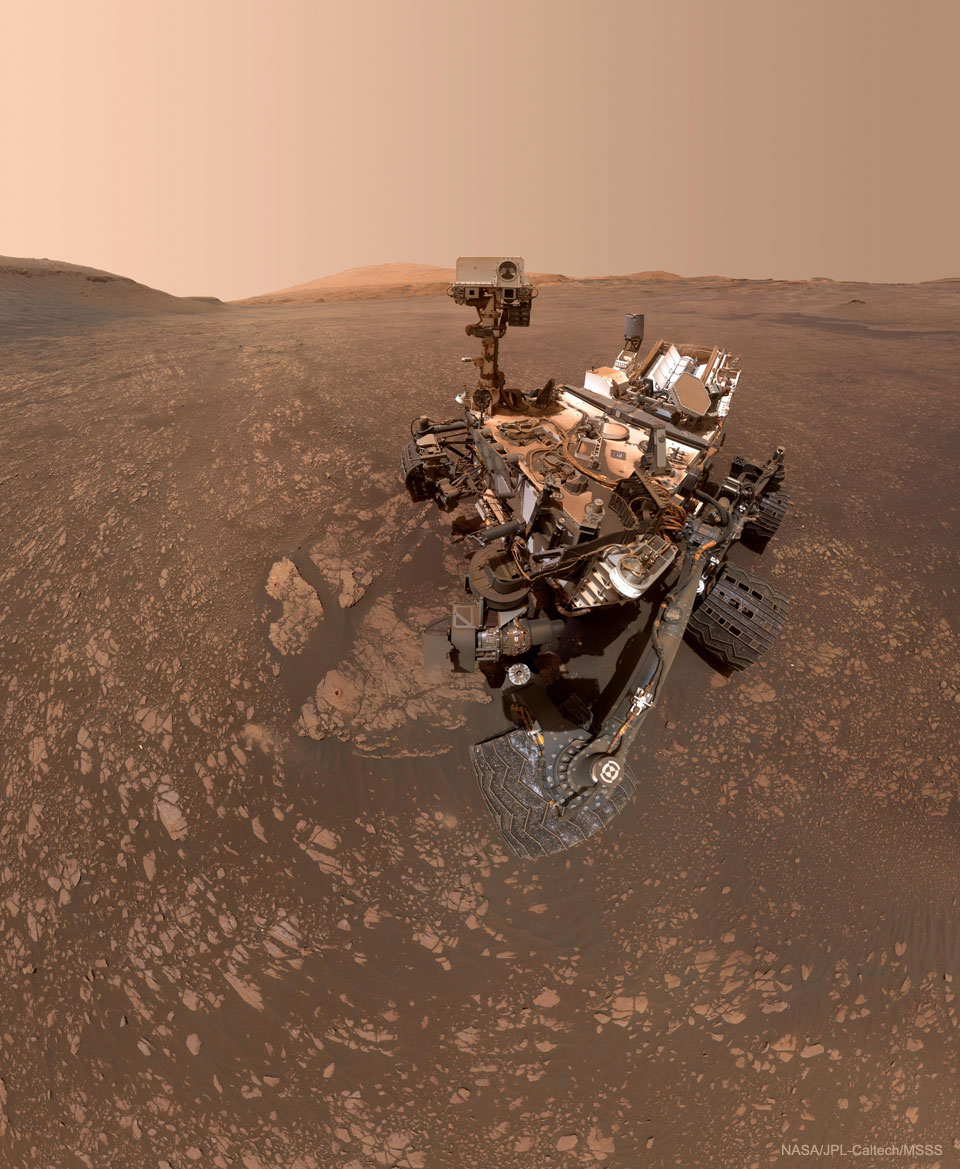
Why is there clay on Mars? On Earth, clay can form at the bottom of a peaceful lake when specific minerals trap water. At the pictured site on Mars, the robotic rover Curiosity drilled into two rocks and found the highest concentration of clay yet. The clay cache is considered addition evidence that Gale Crater once held water in the distant past. Pictured, 57 images taken by Curiosity have been combined into a selfie. The images were taken by a camera at the end of its robotic arm. Many details of the car-sized rover are visible, including its rugged wheels, numerous scientific instruments, and a high mast that contains camera "eyes", one of which can shoot out an infrared laser beam. Curiosity continues to roll around and up Mount Sharp -- in the center of Gale Crater -- in a search for new clues about the ancient history of Mars and whether or not the red planet once had conditions that could support life.