Mars
Mars is the fourth planet from the Sun and the seventh largest in the Solar System. A cold, dusty desert world with a thin atmosphere (mostly CO₂), the planet features extinct volcanoes, deep canyons, polar ice caps, and seasons. Mars has two small moons (Phobos and Deimos), a day just over 24 hours long, and a year lasting about 687 Earth days. It is a prime focus of robotic exploration and studies about past water and habitability.
Source: science.nasa.gov
APODs including "Mars"
Moon, Mars, Saturn, Jupiter, Milky Way
20/05/2020
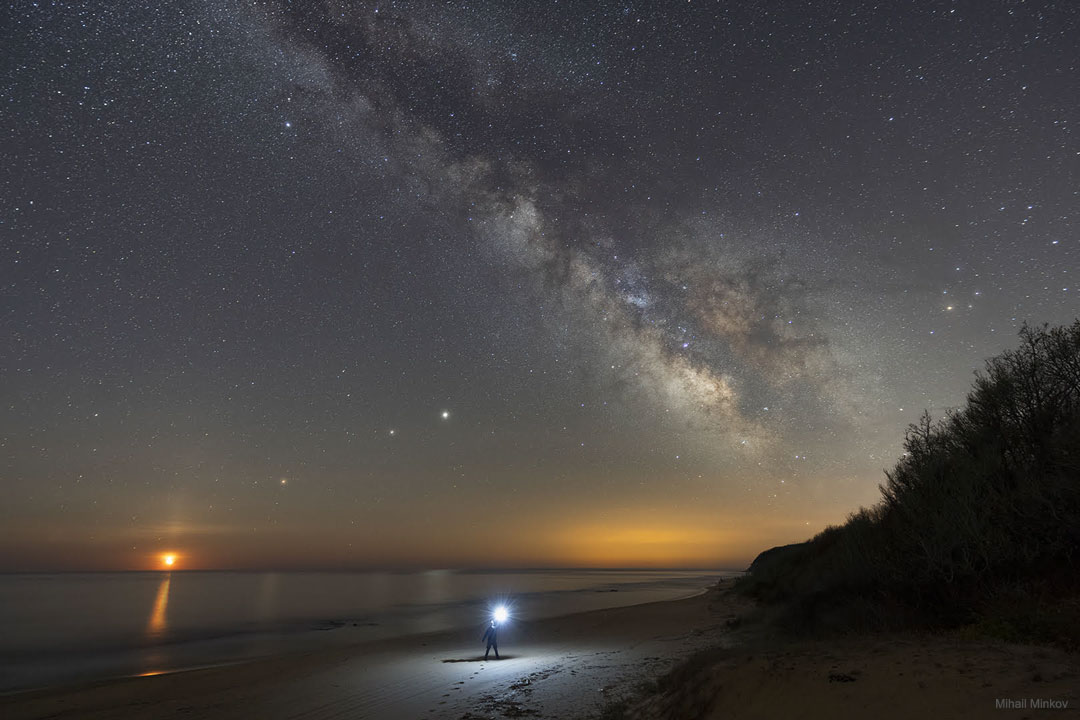
It is not a coincidence that planets line up. That's because all of the planets orbit the Sun in (nearly) a single sheet called the plane of the ecliptic. When viewed from inside that plane -- as Earth dwellers are likely to do -- the planets all appear confined to a single band. It is a coincidence, though, when three of the brightest planets all appear in nearly the same direction. Such a coincidence was captured about a month ago. Featured above, Earth's Moon, Mars, Saturn, and Jupiter were all imaged together, just before sunrise, from the Black Sea coast of Bulgaria. A second band is visible diagonally across this image -- the central band of our Milky Way Galaxy. If you wake up early, you will find that these same planets remain visible in the morning sky this month, too. Astrophysicists: Browse 2,100+ codes in the Astrophysics Source Code Library