Mars
Mars is the fourth planet from the Sun and the seventh largest in the Solar System. A cold, dusty desert world with a thin atmosphere (mostly CO₂), the planet features extinct volcanoes, deep canyons, polar ice caps, and seasons. Mars has two small moons (Phobos and Deimos), a day just over 24 hours long, and a year lasting about 687 Earth days. It is a prime focus of robotic exploration and studies about past water and habitability.
Source: science.nasa.gov
APODs including "Mars"
Solis Lacus: The Eye of Mars
01/10/2020
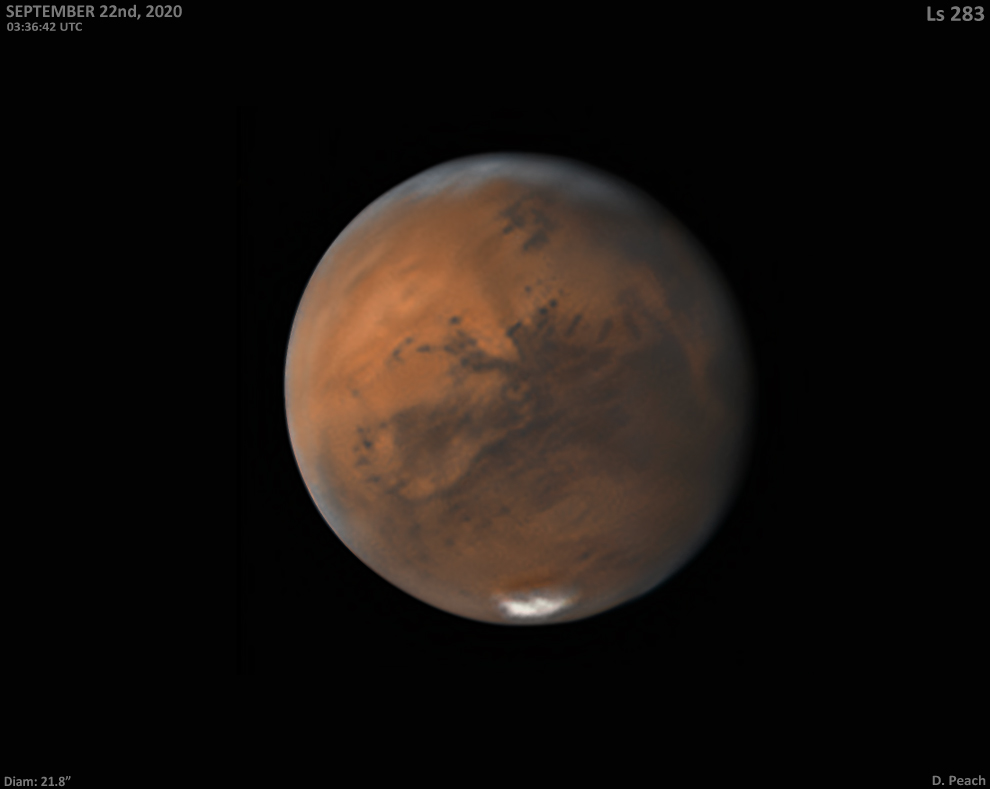
As telescopes around planet Earth watch, Mars is growing brighter in night skies, approaching its 2020 opposition on October 13. Mars looks like it's watching too in this view of the Red Planet from September 22. Mars' disk is already near its maximum apparent size for earthbound telescopes, less than 1/80th the apparent diameter of a Full Moon. The seasonally shrinking south polar cap is at the bottom and hazy northern clouds are at the top. A circular, dark albedo feature, Solis Lacus (Lake of the Sun), is just below and left of disk center. Surrounded by a light area south of Valles Marineris, Solis Lacus looks like a planet-sized pupil, famously known as The Eye of Mars . Near the turn of the 20th century, astronomer and avid Mars watcher Percival Lowell associated the Eye of Mars with a conjunction of canals he charted in his drawings of the Red Planet. Broad, visible changes in the size and shape of the Eye of Mars are now understood from high resolution surface images to be due to dust transported by winds in the thin Martian atmosphere.