Mars
Mars is the fourth planet from the Sun and the seventh largest in the Solar System. A cold, dusty desert world with a thin atmosphere (mostly CO₂), the planet features extinct volcanoes, deep canyons, polar ice caps, and seasons. Mars has two small moons (Phobos and Deimos), a day just over 24 hours long, and a year lasting about 687 Earth days. It is a prime focus of robotic exploration and studies about past water and habitability.
Source: science.nasa.gov
APODs including "Mars"
A Little Like Mars
05/03/2021
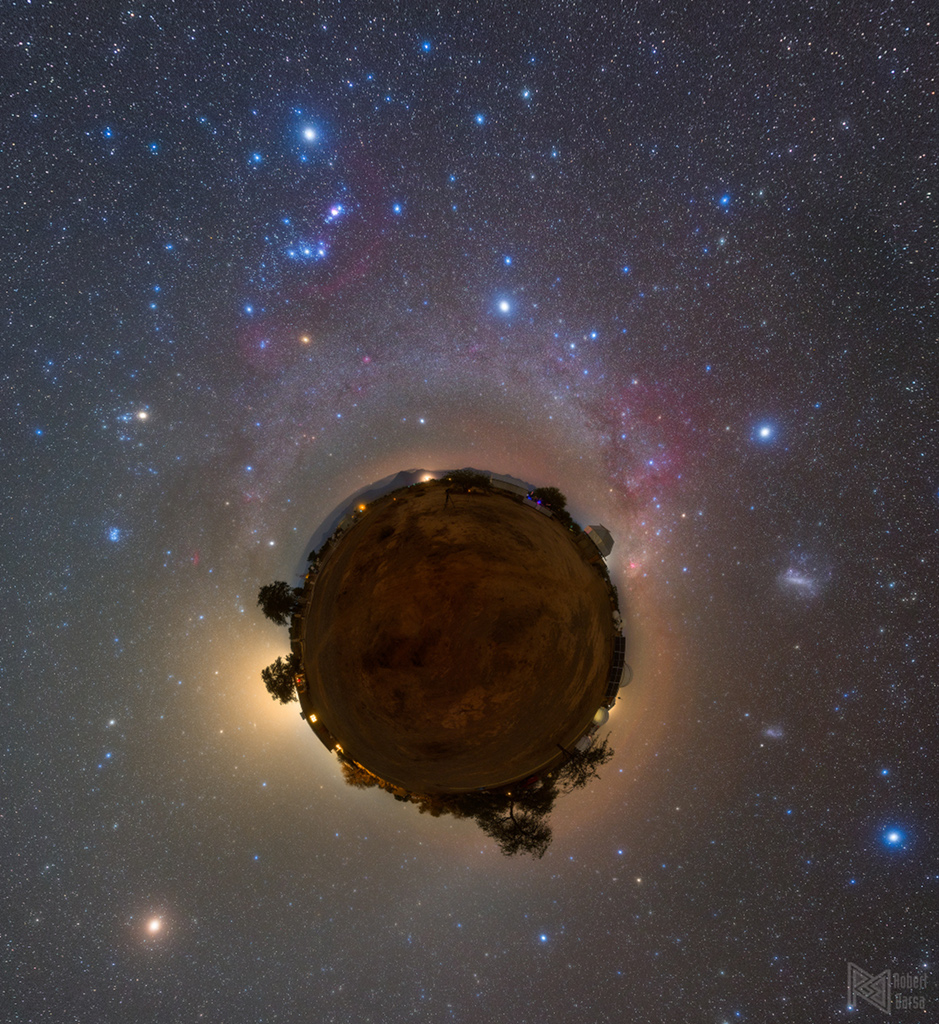
The surface of this planet looks a little like Mars. It's really planet Earth though. In a digitally stitched little planet projection, the 360 degree mosaic was captured near San Pedro in the Chilean Atacama desert. Telescopes in domes on the horizon are taking advantage of the arid region's famously dark, clear nights. Taken in early December, a magnificent Milky Way arcs above the horizon for almost 180 degrees around the little planet with Orion prominent in the southern sky. A familiar constellation upside down for northern hemisphere skygazers, Orion shares that southern December night almost opposite the Large and Small Magellanic clouds. But the Red Planet itself is the brightest yellowish celestial beacon in this little planet sky. Please take a short survey in aesthetics & astronomy: Sonification