Mars
Mars is the fourth planet from the Sun and the seventh largest in the Solar System. A cold, dusty desert world with a thin atmosphere (mostly CO₂), the planet features extinct volcanoes, deep canyons, polar ice caps, and seasons. Mars has two small moons (Phobos and Deimos), a day just over 24 hours long, and a year lasting about 687 Earth days. It is a prime focus of robotic exploration and studies about past water and habitability.
Source: science.nasa.gov
APODs including "Mars"
Introducing Comet Leonard
21/11/2021
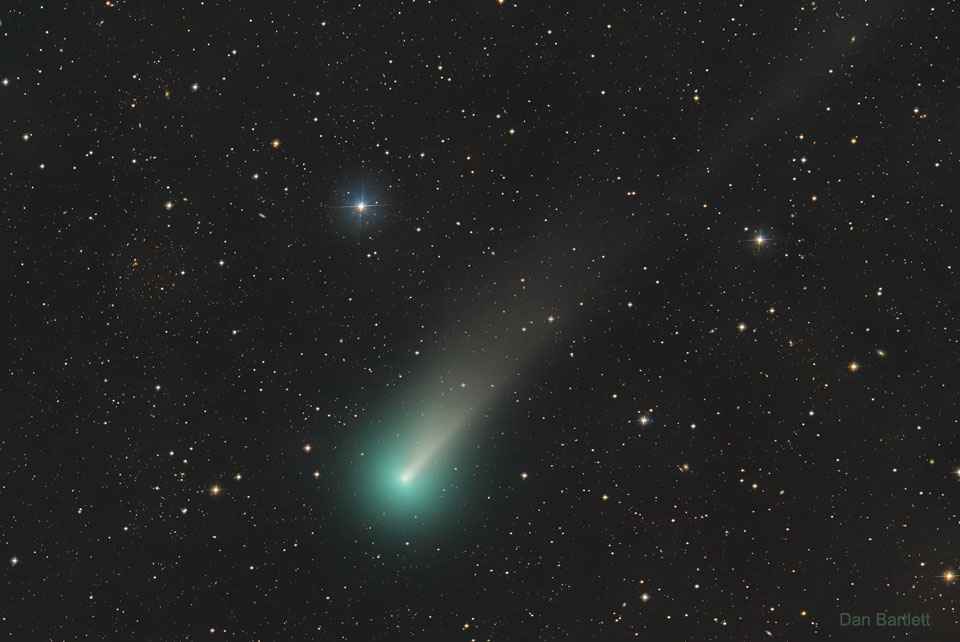
Here comes Comet Leonard. Comet C/2021 A1 (Leonard) was discovered as a faint smudge in January 2021 when it was out past Mars -- but its orbit will take the giant shedding ice-ball into the inner Solar System, passing near both Earth and Venus in December before it swoops around the Sun in early January 2022. Although comets are notoriously hard to predict, some estimations have Comet Leonard brightening to become visible to the unaided eye in December. Comet Leonard was captured just over a week ago already sporting a green-tinged coma and an extended dust tail. The featured picture was composed from 62 images taken through a moderate-sized telescope -- one set of exposures tracking the comet, while another set tracking the background stars. The exposures were taken from the dark skies above the Eastern Sierras (Mountains), near June Lake in California, USA. Soon after passing near the Earth in mid-December, the comet will shift from northern to southern skies. APOD Editor (RJN) Online Monday: NASA's Best Space Images (& Videos)