Mars
Mars is the fourth planet from the Sun and the seventh largest in the Solar System. A cold, dusty desert world with a thin atmosphere (mostly CO₂), the planet features extinct volcanoes, deep canyons, polar ice caps, and seasons. Mars has two small moons (Phobos and Deimos), a day just over 24 hours long, and a year lasting about 687 Earth days. It is a prime focus of robotic exploration and studies about past water and habitability.
Source: science.nasa.gov
APODs including "Mars"
Venus and Mars: Passing in the Night
29/03/2022
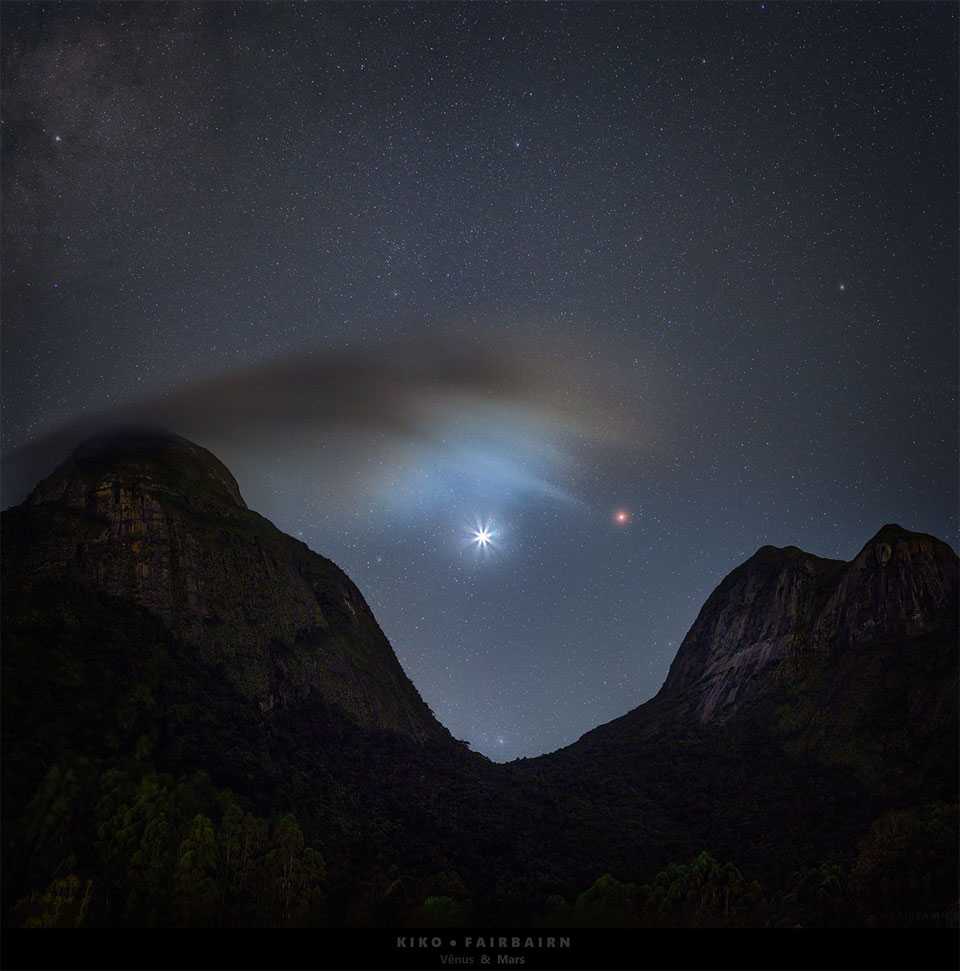
When two planets pass on the night sky, they can usually be seen near each other for a week or more. In the case of this planetary conjunction, Venus and Mars passed within 4 degrees of each other earlier this month. The featured image was taken a few days prior, when Venus was slowing rising in the pre-dawn sky, night by night, while Mars was slowly setting. The image, a four-part mosaic, was captured in Brazil from the small town Teresópolis. Besides Venus and Mars, the morning sky now also includes the more distant planet Saturn. Of course, these conjunctions are only angular -- Venus, Mars, and Saturn continue to orbit the Sun in very different parts of our Solar System. Next week, the angle between Saturn and Mars will drop to below a quarter of a degree.