Mars
Mars is the fourth planet from the Sun and the seventh largest in the Solar System. A cold, dusty desert world with a thin atmosphere (mostly CO₂), the planet features extinct volcanoes, deep canyons, polar ice caps, and seasons. Mars has two small moons (Phobos and Deimos), a day just over 24 hours long, and a year lasting about 687 Earth days. It is a prime focus of robotic exploration and studies about past water and habitability.
Source: science.nasa.gov
APODs including "Mars"
Stars and Planets over Portugal
18/04/2022
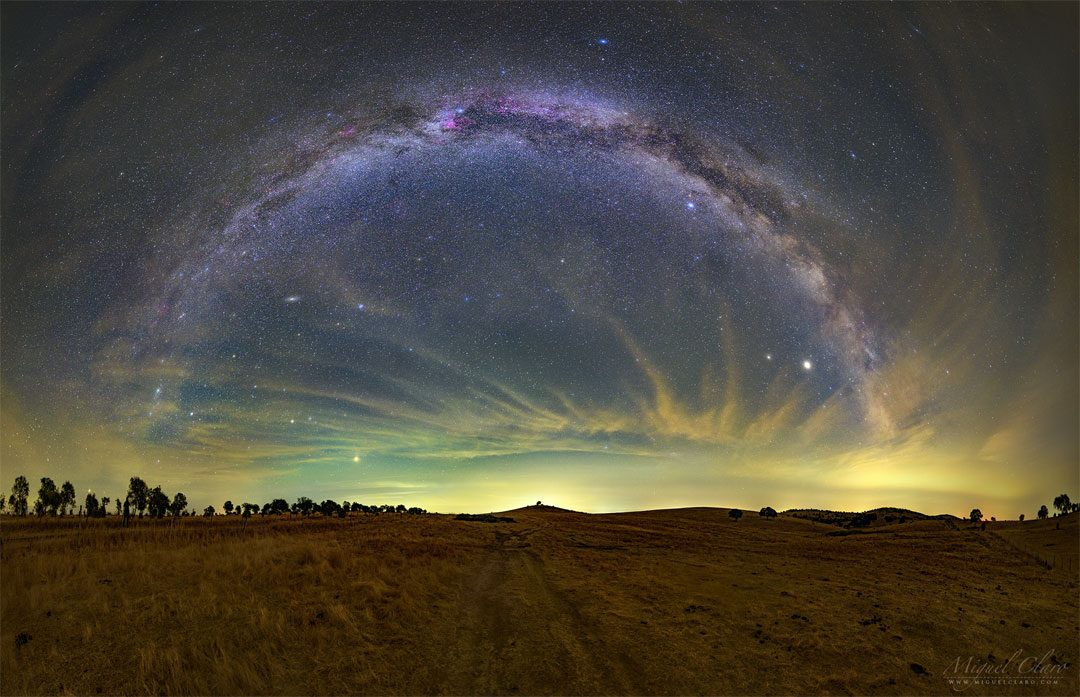
The mission was to document night-flying birds -- but it ended up also documenting a beautiful sky. The featured wide-angle mosaic was taken over the steppe golden fields in Mértola, Portugal in 2020. From such a dark location, an immediately-evident breathtaking glow arched over the night sky: the central band of our Milky Way galaxy. But this sky had much more. Thin clouds crossed the sky like golden ribbons. The planet Mars appeared on the far left, while the planets Saturn and Jupiter were also simultaneously visible -- but on the opposite side of the sky, here seen on the far right. Near the top of the image the bright star Vega can be found, while the far-distant and faint Andromeda Galaxy can be seen toward the left, just below Milky Way's arch. As the current month progresses, several planets are lining up in the pre-dawn sky: Jupiter, Venus, Mars, and Saturn. Did you know? Many APODs have links for adventure & humor