Mars
Mars is the fourth planet from the Sun and the seventh largest in the Solar System. A cold, dusty desert world with a thin atmosphere (mostly CO₂), the planet features extinct volcanoes, deep canyons, polar ice caps, and seasons. Mars has two small moons (Phobos and Deimos), a day just over 24 hours long, and a year lasting about 687 Earth days. It is a prime focus of robotic exploration and studies about past water and habitability.
Source: science.nasa.gov
APODs including "Mars"
Planets Over Egyptian Pyramid
04/05/2022
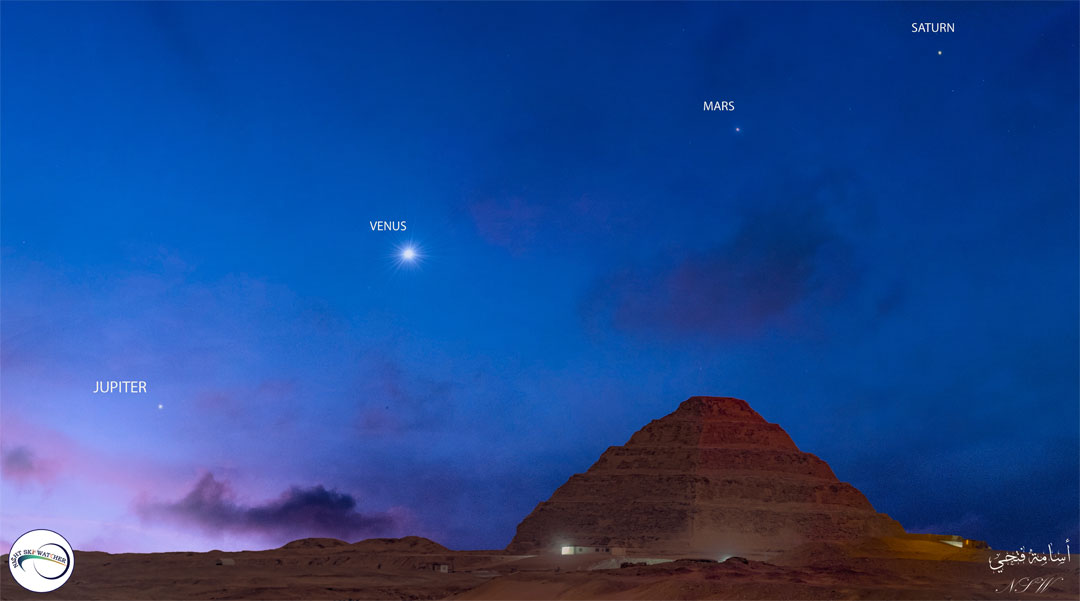
The early morning planet parade continues. Visible the world over, the planets Jupiter, Venus, Mars and Saturn have been lining up in the pre-dawn sky since mid-April. In the featured image taken last month, these planets were captured over the Step Pyramid of Djoser, a UNESCO World Heritage Site. Located in the Saqqara necropolis of Egypt, the pyramid was constructed in the 27th century BC and is one of the oldest pyramids known. The two-image composite includes a foreground image taken during evening blue hour, and a background image captured from the same location the following morning. The morning planet line-up is slowly changing. At the end of last month, planets Jupiter and Venus switched places, while at the end of this month, Jupiter and Mars will switch after passing within one-degree of each other. Of course, this picturesque planetary angular alignment is a coincidence, as all of these worlds continue to orbit the Sun as they have for billions of years, well before even the ancient Pyramid of Djoser was built. Notable Submissions to APOD: Morning Planet Parade 2022