Mars
Mars is the fourth planet from the Sun and the seventh largest in the Solar System. A cold, dusty desert world with a thin atmosphere (mostly CO₂), the planet features extinct volcanoes, deep canyons, polar ice caps, and seasons. Mars has two small moons (Phobos and Deimos), a day just over 24 hours long, and a year lasting about 687 Earth days. It is a prime focus of robotic exploration and studies about past water and habitability.
Source: science.nasa.gov
APODs including "Mars"
Siccar Point on Mars
31/08/2022
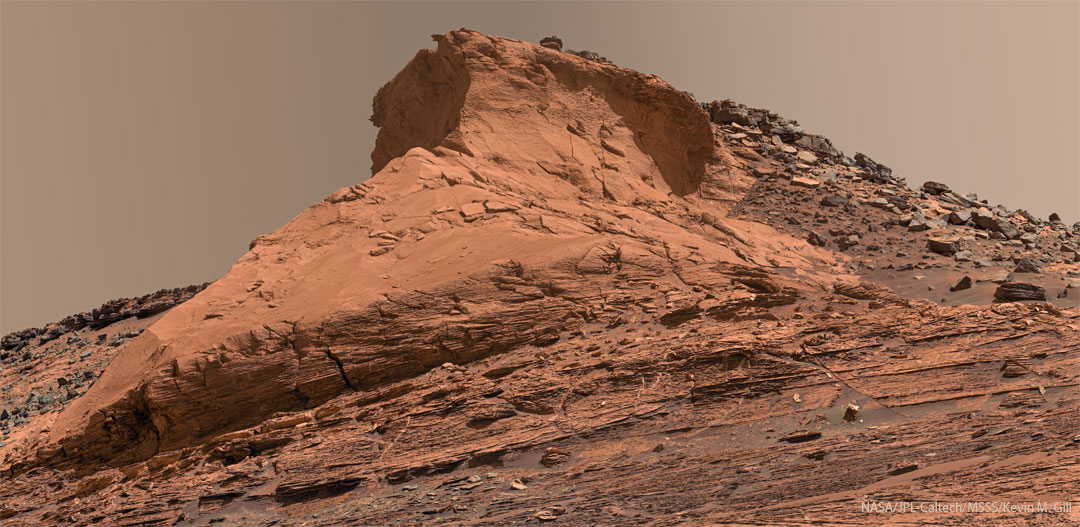
What created this unusual hill on Mars? No one is sure. A good outlook to survey the surrounding area, Siccar Point stands out from its surroundings in Gale Crater. The unusual mound was visited by the robotic Curiosity rover exploring Mars late last year. Siccar Point not only has a distinctive shape, it has dark rocks above lighter rocks. The apparent much younger age of the dark rocks indicates a time-break in the usual geological ordering of rock layers -- by a process yet unknown. The Martian hill is named for Siccar Point on Earth, a place in Scotland itself distinctive as a junction between two different rock layers. Curiosity continues to explore Gale crater on Mars, looking for clues of ancient life. Simultaneously, 2300 kilometers away, its sister rover Perseverance explores Jezero crater, there assisted by the flight-capable scout Ingenuity.