Mars
Mars is the fourth planet from the Sun and the seventh largest in the Solar System. A cold, dusty desert world with a thin atmosphere (mostly CO₂), the planet features extinct volcanoes, deep canyons, polar ice caps, and seasons. Mars has two small moons (Phobos and Deimos), a day just over 24 hours long, and a year lasting about 687 Earth days. It is a prime focus of robotic exploration and studies about past water and habitability.
Source: science.nasa.gov
APODs including "Mars"
Mars Rises above the Lunar Limb
09/12/2022
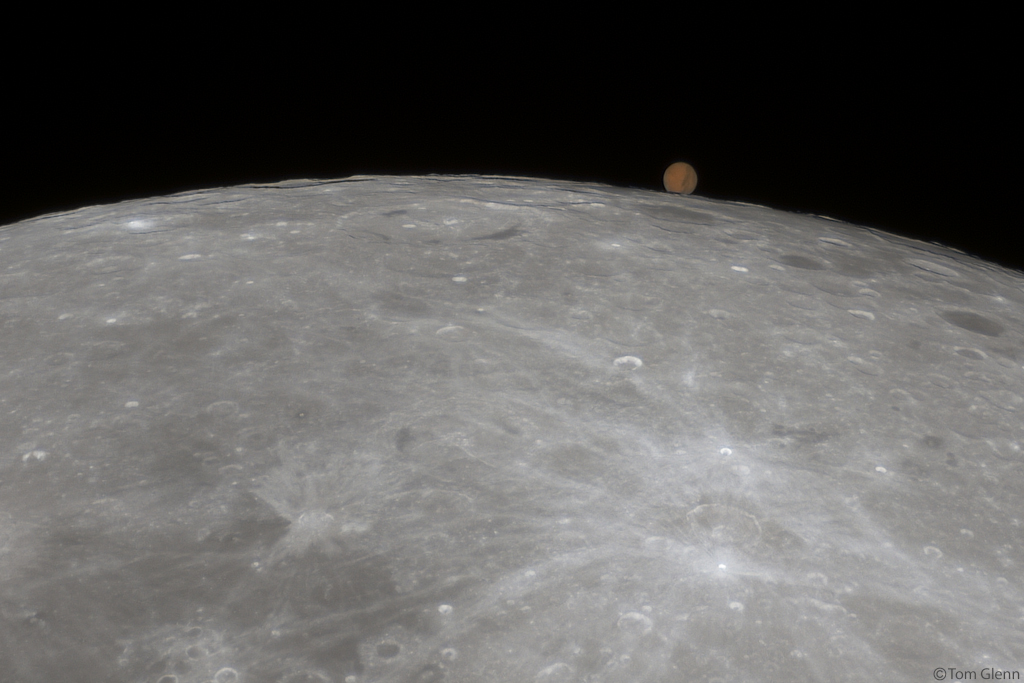
On the night of December 7 Mars wandered near the Full Moon. In fact the Red Planet was occulted, passing behind the Moon, when viewed from locations across Europe and North America. About an hour after disappearing behind the lunar disk Mars reappears in this stack of sharp video frames captured from San Diego, planet Earth. With the Moon in the foreground Mars was a mere 82 million kilometers distant, near its own opposition. Full Moon and full Mars were bright enough to provide the spectacular image with no exposure adjustments necessary. In the image Mars appears to rise just over ancient, dark-floored, lunar crater Abel very close to the southeastern edge of the Moon's near side. Humboldt is the large impact crater to its north (left).