Mars
Mars is the fourth planet from the Sun and the seventh largest in the Solar System. A cold, dusty desert world with a thin atmosphere (mostly CO₂), the planet features extinct volcanoes, deep canyons, polar ice caps, and seasons. Mars has two small moons (Phobos and Deimos), a day just over 24 hours long, and a year lasting about 687 Earth days. It is a prime focus of robotic exploration and studies about past water and habitability.
Source: science.nasa.gov
APODs including "Mars"
Mars and the Star Clusters
30/12/2022
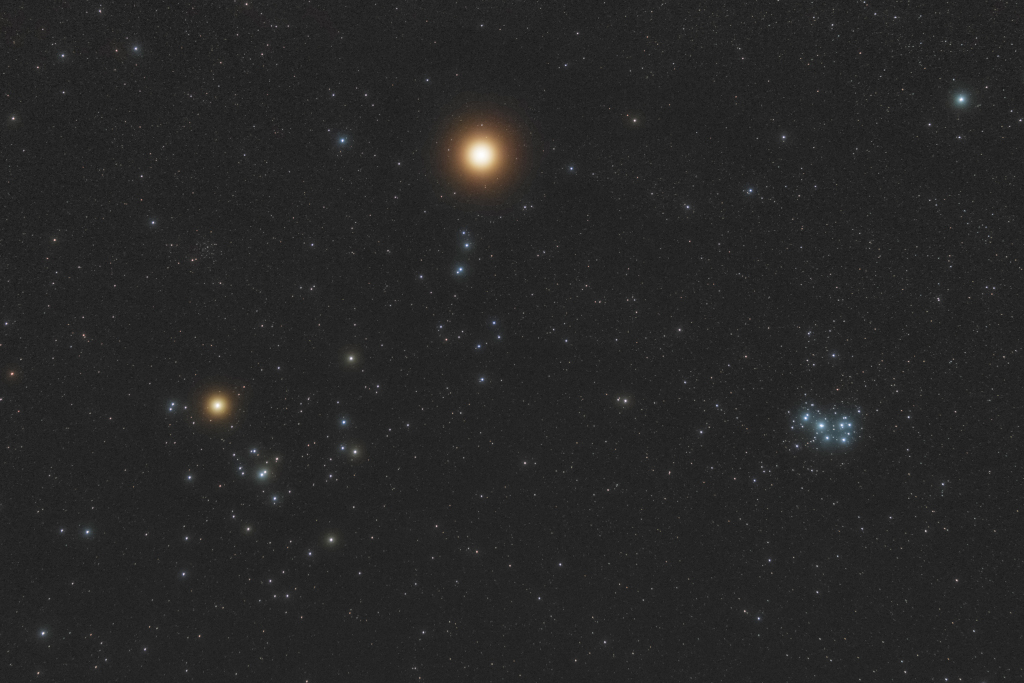
At this year's end Mars still shines brightly in planet Earth's night as it wanders through the head-strong constellation Taurus. Its bright yellowish hue dominates this starry field of view that includes Taurus' alpha star Aldebaran and the Hyades and Pleiades star clusters. While red giant Aldebaran appears to anchor the V-shape of the Hyades at the left of the frame, Aldebaran is not a member of the Hyades star cluster. The Hyades cluster is 151 light-years away making it the nearest established open star cluster, but Aldebaran lies at less than half that distance, along the same line-of-sight. At the right, some 400 light-years distant is the open star cluster cataloged as Messier 45, also known as the Pleiades or Seven Sisters. In Greek myth, the Pleiades were daughters of the astronomical titan Atlas and sea-nymph Pleione.