Mars
Mars is the fourth planet from the Sun and the seventh largest in the Solar System. A cold, dusty desert world with a thin atmosphere (mostly CO₂), the planet features extinct volcanoes, deep canyons, polar ice caps, and seasons. Mars has two small moons (Phobos and Deimos), a day just over 24 hours long, and a year lasting about 687 Earth days. It is a prime focus of robotic exploration and studies about past water and habitability.
Source: science.nasa.gov
APODs including "Mars"
Jupiter and Venus Converge over Germany
15/03/2023
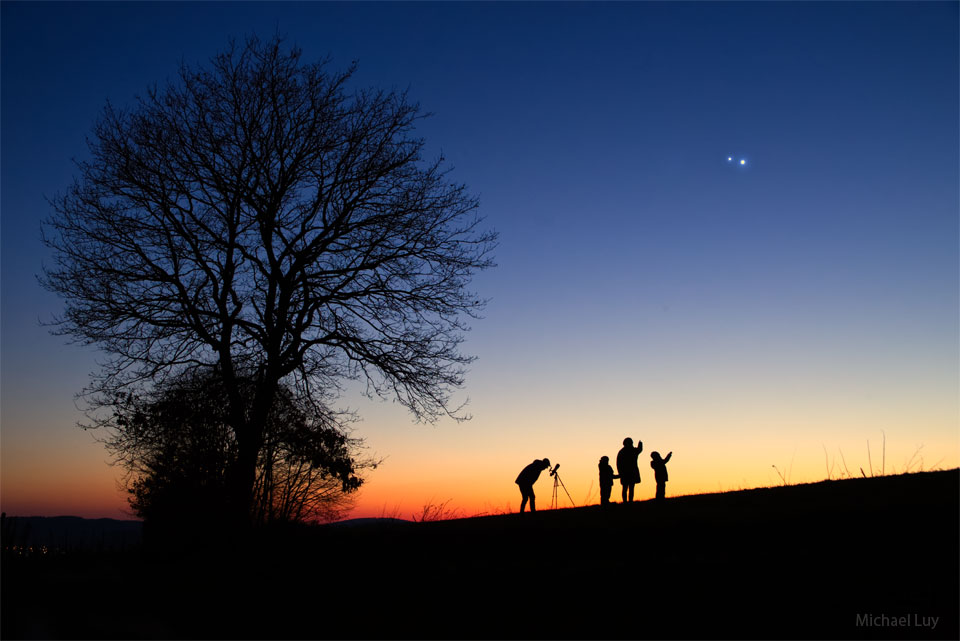
This was a sky to show the kids. Early this month the two brightest planets in the night sky, Jupiter and Venus, appeared to converge. At their closest, the two planets were separated by only about the angular width of the full moon. The spectacle occurred just after sunset and was seen and photographed all across planet Earth. The displayed image was taken near to the time of closest approach from Wiltingen, Germany, and features the astrophotographer, spouse, and their two children. Of course, Venus remains much closer to both the Sun and the Earth than Jupiter -- the apparent closeness between the planets in the sky of Earth was only angular. Jupiter and Venus have passed and now appear increasingly far apart. Similar planetary convergence opportunities will eventually arise. In a few months, for example, Mars and Venus will appear to congregate just as the Sun sets. Jupiter & Venus Conjunction Gallery: Notable Submissions to APOD