Mars
Mars is the fourth planet from the Sun and the seventh largest in the Solar System. A cold, dusty desert world with a thin atmosphere (mostly CO₂), the planet features extinct volcanoes, deep canyons, polar ice caps, and seasons. Mars has two small moons (Phobos and Deimos), a day just over 24 hours long, and a year lasting about 687 Earth days. It is a prime focus of robotic exploration and studies about past water and habitability.
Source: science.nasa.gov
APODs including "Mars"
Olympus Mons: Largest Volcano in the Solar System
04/04/2023
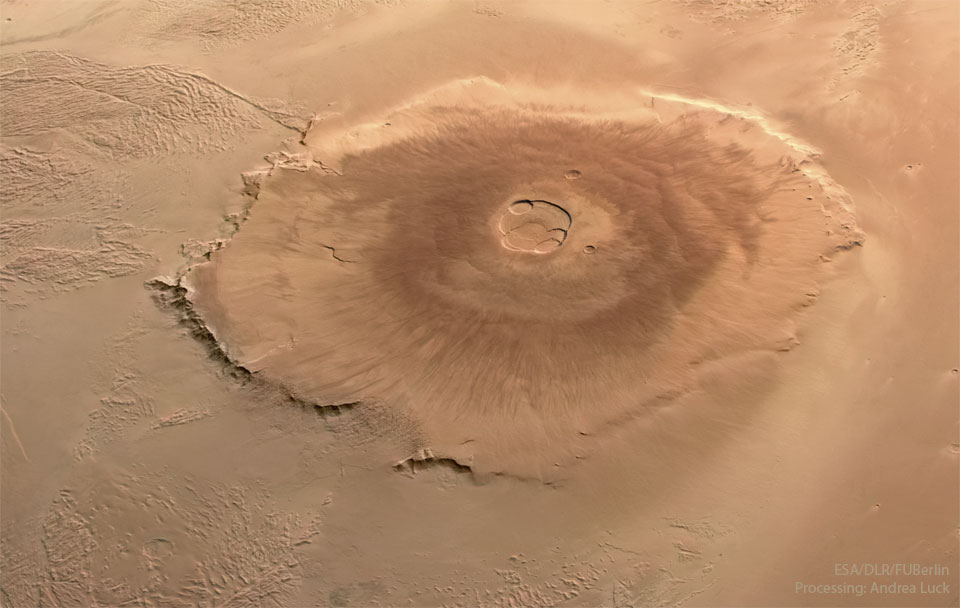
The largest volcano in our Solar System is on Mars. Although three times higher than Earth's Mount Everest, Olympus Mons will not be difficult for humans to climb because of the volcano's shallow slopes and Mars' low gravity. Covering an area greater than the entire Hawaiian volcano chain, the slopes of Olympus Mons typically rise only a few degrees at a time. Olympus Mons is an immense shield volcano, built long ago by fluid lava. A relatively static surface crust allowed it to build up over time. Its last eruption is thought to have been about 25 million years ago. The featured image was taken by the European Space Agency's robotic Mars Express spacecraft currently orbiting the Red Planet. Your Sky Surprise: What picture did APOD feature on your birthday? (post 1995)