Mars
Mars is the fourth planet from the Sun and the seventh largest in the Solar System. A cold, dusty desert world with a thin atmosphere (mostly CO₂), the planet features extinct volcanoes, deep canyons, polar ice caps, and seasons. Mars has two small moons (Phobos and Deimos), a day just over 24 hours long, and a year lasting about 687 Earth days. It is a prime focus of robotic exploration and studies about past water and habitability.
Source: science.nasa.gov
APODs including "Mars"
Flat Rock Hills on Mars
02/05/2023
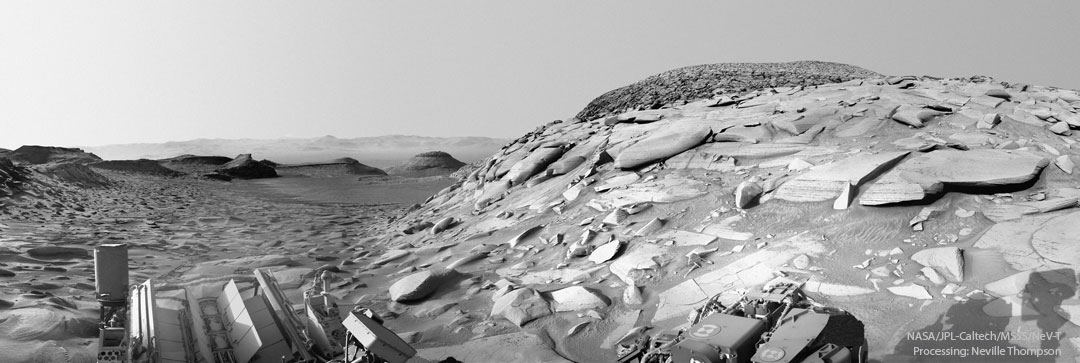
Why are there so many flat rocks on Mars? Some views of plains and hills on Mars show many rocks that are unusually flat when compared to rocks on Earth. One reason for this is a process that is common to both Mars and Earth: erosion. The carbon-dioxide wind on Mars can act like sandpaper when it blows around gritty Martian sand. This sand can create differential erosion, smoothing over some rocks, while wearing down the tops of other long-exposed stones. The featured image capturing several hills covered with flat-topped rocks was taken last month by NASA's Curiosity Rover on Mars. This robotic rover has now been rolling across Mars for ten years and has helped uncover many details of the wet and windy past of Earth's planetary neighbor. After taking this and other images, Curiosity carefully navigated stones and slippery sand to climb up Marker Band Valley.