Mars
Mars is the fourth planet from the Sun and the seventh largest in the Solar System. A cold, dusty desert world with a thin atmosphere (mostly CO₂), the planet features extinct volcanoes, deep canyons, polar ice caps, and seasons. Mars has two small moons (Phobos and Deimos), a day just over 24 hours long, and a year lasting about 687 Earth days. It is a prime focus of robotic exploration and studies about past water and habitability.
Source: science.nasa.gov
APODs including "Mars"
Halley Dust, Mars Dust, and Milky Way
12/05/2023
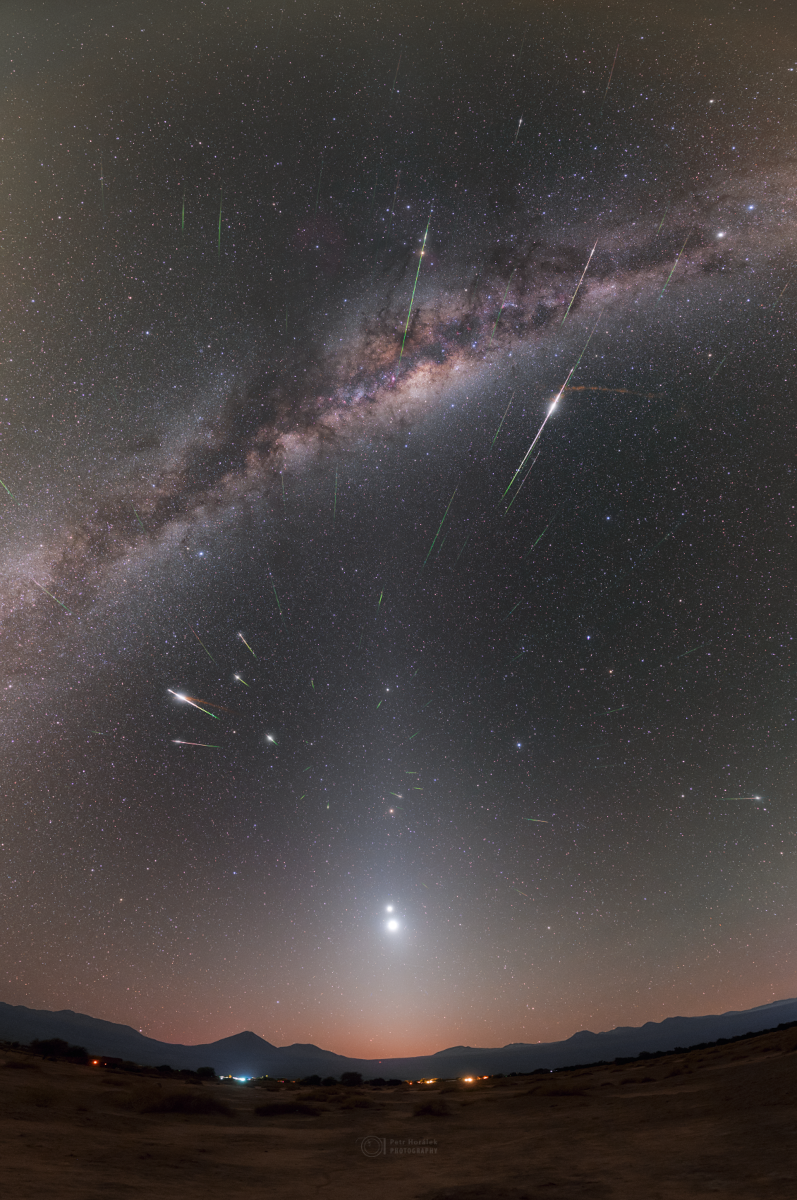
Grains of cosmic dust streaked through night skies in early May. Swept up as planet Earth plowed through the debris streams left behind by periodic Comet Halley, the annual meteor shower is known as the Eta Aquarids. This year, the Eta Aquarids peak was visually hampered by May's bright Full Moon, though. But early morning hours surrounding last May's shower of Halley dust were free of moonlight interference. In exposures recorded between April 28 and May 8 in 2022, this composited image shows nearly 90 Eta Aquarid meteors streaking from the shower's radiant in Aquarius over San Pedro de Atacama, Chile. The central Milky Way arcs above in the southern hemisphere's predawn skies. The faint band of light rising from the horizon is Zodiacal light, caused by dust scattering sunlight near our Solar System's ecliptic plane. Along the ecliptic and entrained in the Zodiacal glow are the bright planets Venus, Jupiter, Mars, and Saturn. Of course Mars itself has recently been found to be a likely source of the dust along the ecliptic responsible for creating Zodiacal light.