Mars
Mars is the fourth planet from the Sun and the seventh largest in the Solar System. A cold, dusty desert world with a thin atmosphere (mostly CO₂), the planet features extinct volcanoes, deep canyons, polar ice caps, and seasons. Mars has two small moons (Phobos and Deimos), a day just over 24 hours long, and a year lasting about 687 Earth days. It is a prime focus of robotic exploration and studies about past water and habitability.
Source: science.nasa.gov
APODs including "Mars"
Lightning on Jupiter
25/06/2023
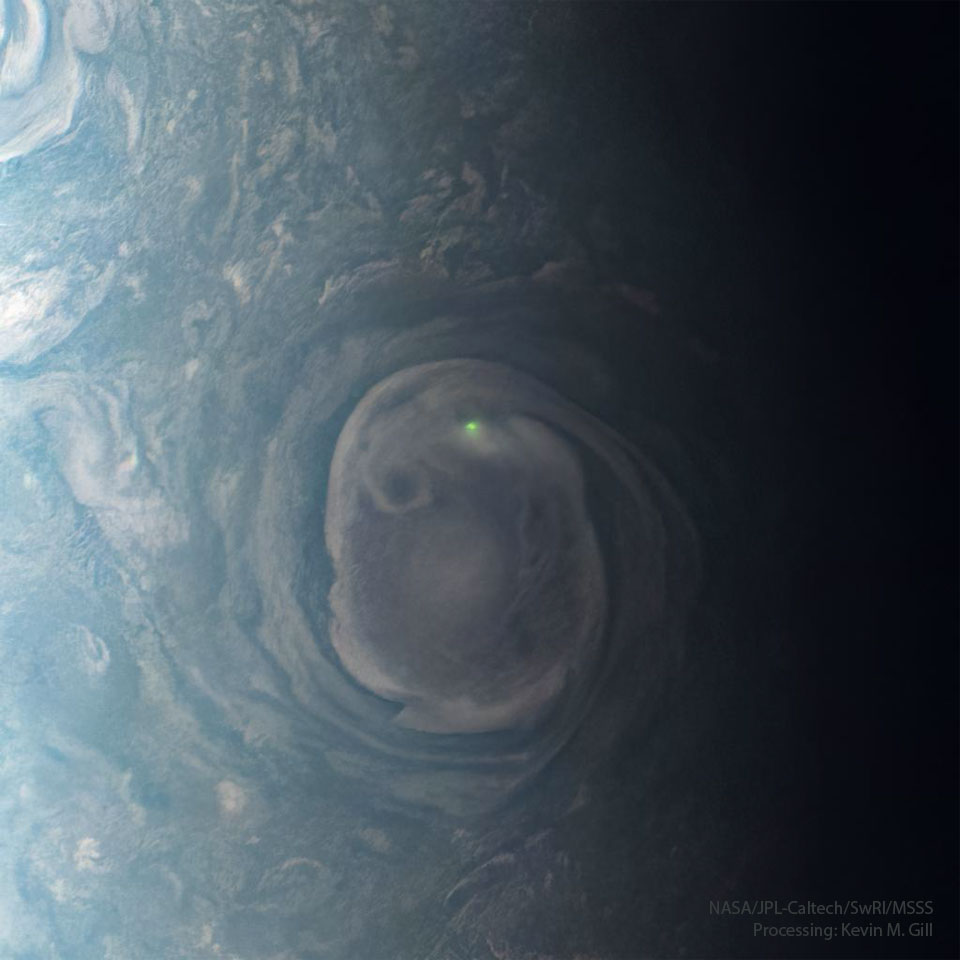
Does lightning occur only on Earth? No. Spacecraft in our Solar System have detected lightning on other planets, including Mars, Jupiter and Saturn, and lightning is likely on Venus, Uranus, and Neptune. Lightning is a sudden rush of electrically charged particles from one location to another. On Earth, drafts of colliding ice and water droplets usually create lightning-generating charge separation, but what happens on Jupiter? Images and data from NASA's Jupiter-orbiting Juno spacecraft bolster previous speculation that Jovian lightning is also created in clouds containing water and ice. In the featured Juno photograph, an optical flash was captured in a large cloud vortex near Jupiter's north pole. During the next few months, Juno will perform several close sweeps over Jupiter's night side, likely allowing the robotic probe to capture more data and images of Jovian lightning.