Mars
Mars is the fourth planet from the Sun and the seventh largest in the Solar System. A cold, dusty desert world with a thin atmosphere (mostly CO₂), the planet features extinct volcanoes, deep canyons, polar ice caps, and seasons. Mars has two small moons (Phobos and Deimos), a day just over 24 hours long, and a year lasting about 687 Earth days. It is a prime focus of robotic exploration and studies about past water and habitability.
Source: science.nasa.gov
APODs including "Mars"
Northern Pluto
18/08/2023
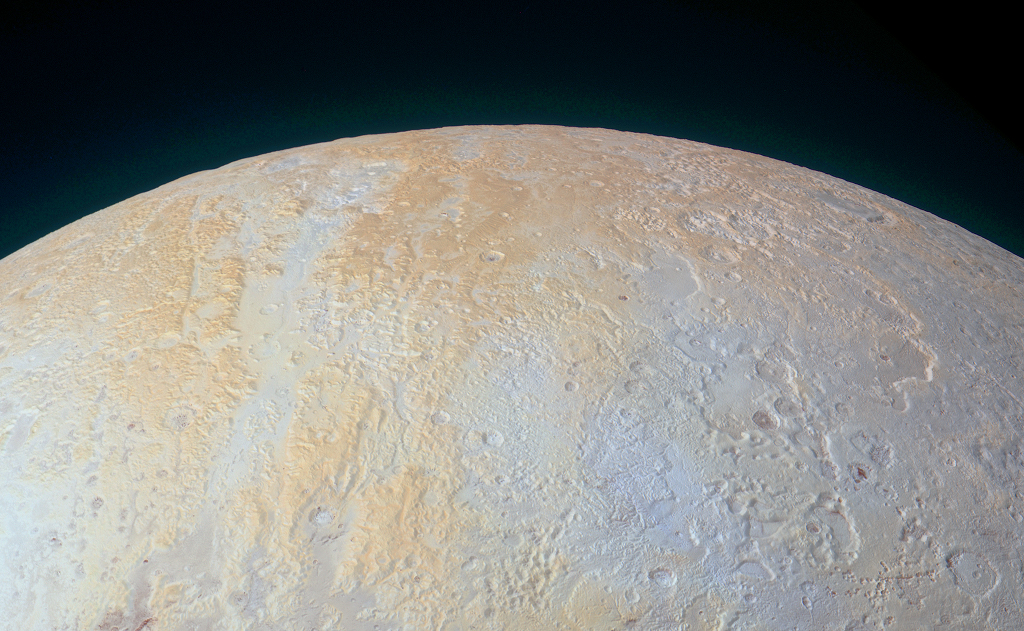
Gaze across the frozen canyons of northern Pluto in this contrast enhanced color scene. The image data used to construct it was acquired in July 2015 by the New Horizons spacecraft as it made the first reconnaissance flight through the remote Pluto system six billion kilometers from the Sun. Now known as Lowell Regio, the region was named for Percival Lowell, founder of the Lowell Observatory. Also famous for his speculation that there were canals on Mars, Lowell started the search that ultimately led to Pluto's discovery in 1930 by Clyde Tombaugh. In this frame Pluto's North Pole is above and left of center. The pale bluish floor of the broad canyon on the left is about 70 kilometers (45 miles) wide, running vertically toward the south. Higher elevations take on a yellowish hue. New Horizon's measurements were used to determine that in addition to nitrogen ice, methane ice is abundant across Lowell Regio. So far, Pluto is the only Solar System world named by an 11-year-old girl.