Mars
Mars is the fourth planet from the Sun and the seventh largest in the Solar System. A cold, dusty desert world with a thin atmosphere (mostly CO₂), the planet features extinct volcanoes, deep canyons, polar ice caps, and seasons. Mars has two small moons (Phobos and Deimos), a day just over 24 hours long, and a year lasting about 687 Earth days. It is a prime focus of robotic exploration and studies about past water and habitability.
Source: science.nasa.gov
APODs including "Mars"
Planet Earth from Orion
18/11/2023
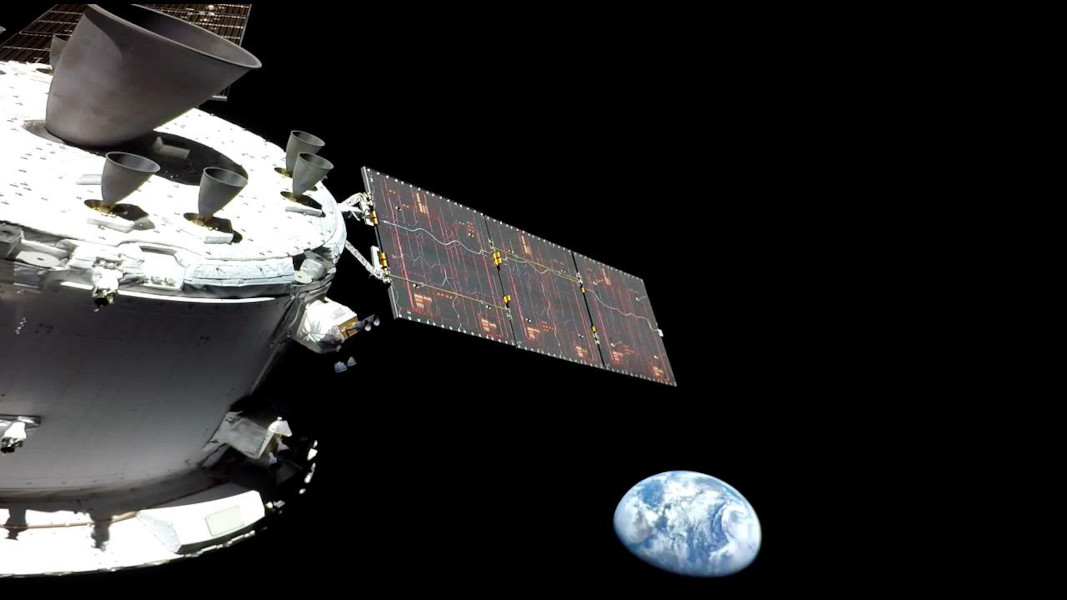
One year ago a Space Launch System rocket left planet Earth on November 16, 2022 at 1:47am EST carrying the Orion spacecraft on the Artemis I mission, the first integrated test of NASA’s deep space exploration systems. Over an hour after liftoff from Kennedy Space Center's historic Launch Complex 39B, one of Orion's external video cameras captured this view of its new perspective from space. In the foreground are Orion's Orbital Maneuvering System engine and auxillary engines, at the bottom of the European Service Module. Beyond one of the module's 7-meter long extended solar array wings lies the spacecraft's beautiful home world. Making close flybys of the lunar surface and reaching a retrograde orbit 70,000 kilometers beyond the Moon, the uncrewed Artemis I mission lasted over 25 days, testing capabilities to enable human exploration of the Moon and Mars. Building on the success of Artemis I, no earlier than November 2024 the Artemis II mission with a crew of 4 will venture around the Moon and back again.