Mars
Mars is the fourth planet from the Sun and the seventh largest in the Solar System. A cold, dusty desert world with a thin atmosphere (mostly CO₂), the planet features extinct volcanoes, deep canyons, polar ice caps, and seasons. Mars has two small moons (Phobos and Deimos), a day just over 24 hours long, and a year lasting about 687 Earth days. It is a prime focus of robotic exploration and studies about past water and habitability.
Source: science.nasa.gov
APODs including "Mars"
Aurora and Milky Way over Norway
12/12/2023
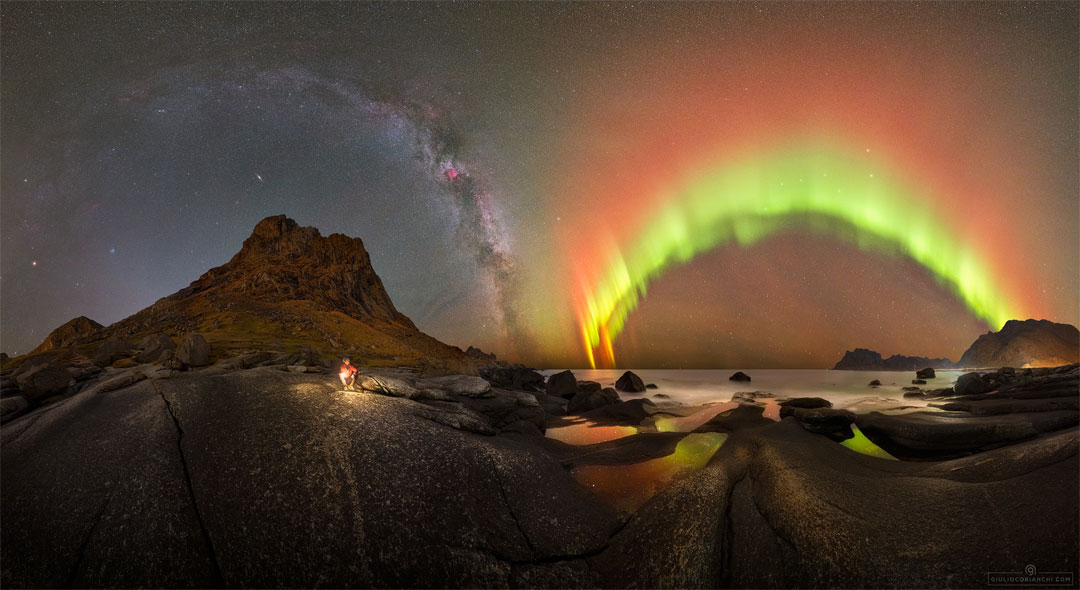
What are these two giant arches across the sky? Perhaps the more familiar one, on the left, is the central band of our Milky Way Galaxy. This grand disk of stars and nebulas here appears to encircle much of the southern sky. Visible below the stellar arch is the rusty-orange planet Mars and the extended Andromeda galaxy. But this night had more! For a few minutes during this cold arctic night, a second giant arch appeared encircling part of the northern sky: an aurora. Auroras are much closer than stars as they are composed of glowing air high in Earth's atmosphere. Visible outside the green auroral arch is the group of stars popularly known as the Big Dipper. The featured digital composite of 20 images was captured in mid-November 2022 over the Lofoten Islands in Norway. APOD Year in Review (2023): RJN's Night Sky Network Lecture