Mars
Mars is the fourth planet from the Sun and the seventh largest in the Solar System. A cold, dusty desert world with a thin atmosphere (mostly CO₂), the planet features extinct volcanoes, deep canyons, polar ice caps, and seasons. Mars has two small moons (Phobos and Deimos), a day just over 24 hours long, and a year lasting about 687 Earth days. It is a prime focus of robotic exploration and studies about past water and habitability.
Source: science.nasa.gov
APODs including "Mars"
The Shadow of Ingenuity's Damaged Rotor Blade
10/02/2024
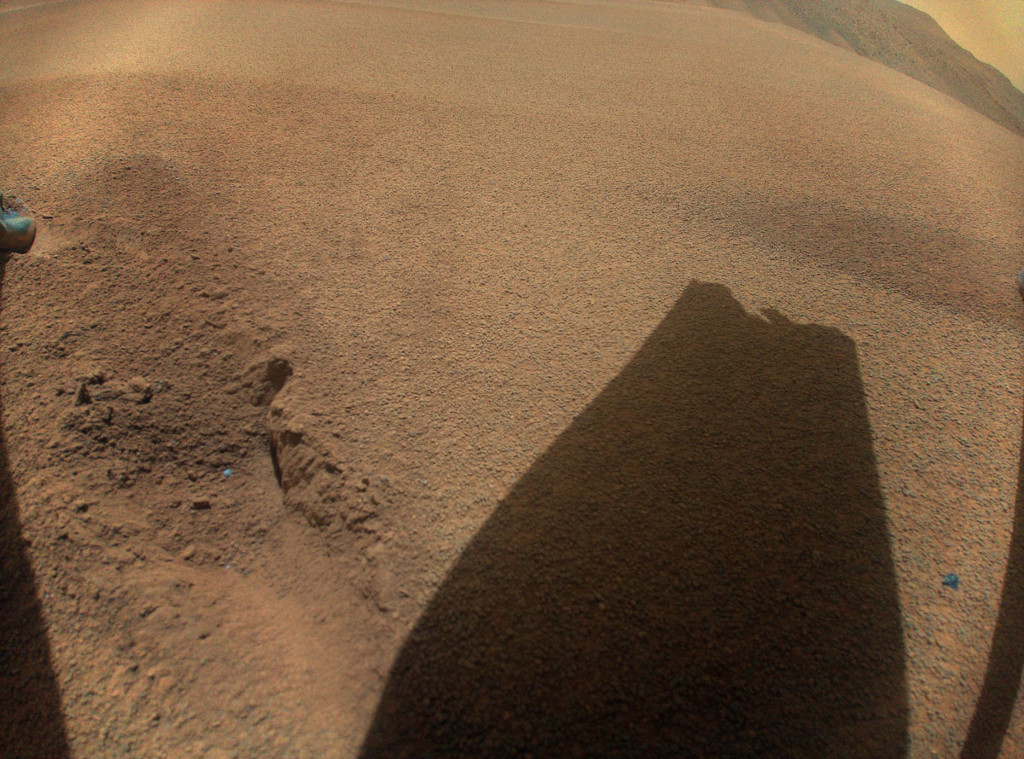
On January 18, 2024, during its 72nd flight in the thin Martian atmosphere, autonomous Mars Helicopter Ingenuity rose to an altitude of 12 meters (40 feet) and hovered for 4.5 seconds above the Red Planet. Ingenuity's 72nd landing was a rough one though. During descent it lost contact with the Perseverance rover about 1 meter above the Martian surface. Ingenuity was able to transmit this image after contact was re-established, showing the shadow of one of its rotor blades likely damaged during landing. And so, after wildly exceeding expectations during over 1,000 days of exploring Mars, the history-making Ingenuity has ended its flight operations. Nicknamed Ginny, Mars Helicopter Ingenuity became the first aircraft to achieve powered, controlled flight on another planet on April 19, 2021. Before launch, a small piece of material from the lower-left wing of the Wright Brothers Flyer 1, the first aircraft to achieve powered, controlled flight on planet Earth, was fixed to the underside of Ingenuity's solar panel.