Mars
Mars is the fourth planet from the Sun and the seventh largest in the Solar System. A cold, dusty desert world with a thin atmosphere (mostly CO₂), the planet features extinct volcanoes, deep canyons, polar ice caps, and seasons. Mars has two small moons (Phobos and Deimos), a day just over 24 hours long, and a year lasting about 687 Earth days. It is a prime focus of robotic exploration and studies about past water and habitability.
Source: science.nasa.gov
APODs including "Mars"
Phobos: Moon over Mars
22/03/2024
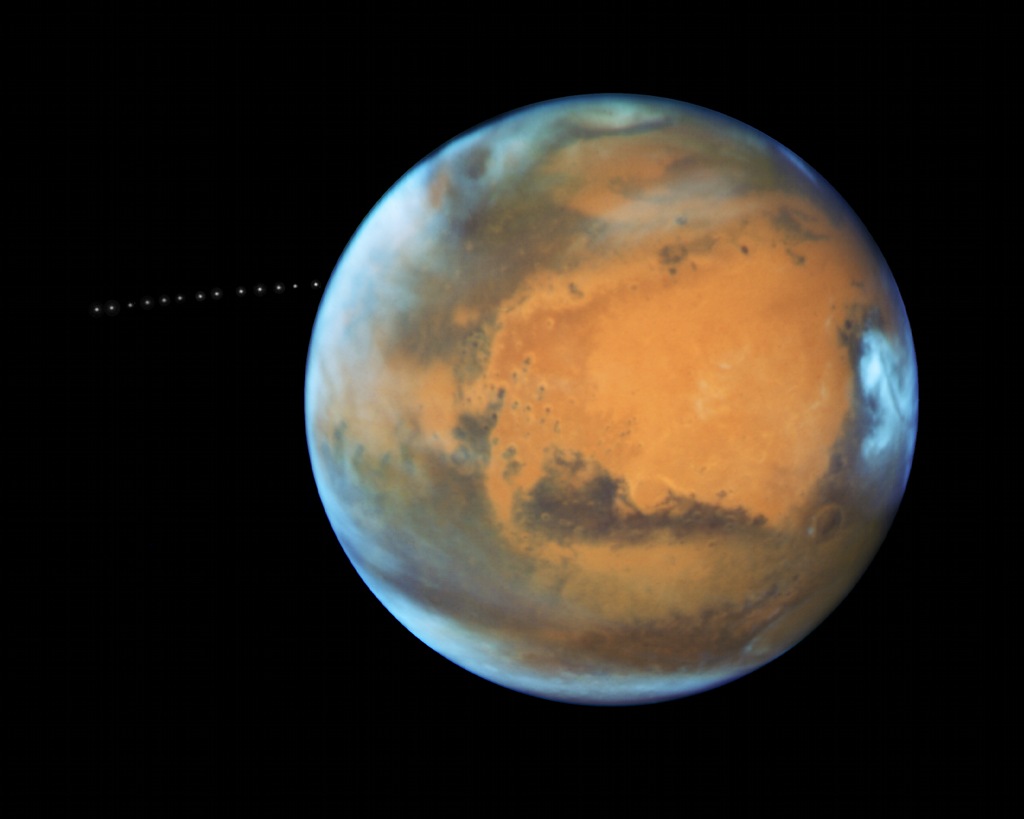
A tiny moon with a scary name, Phobos emerges from behind the Red Planet in this timelapse sequence from the Earth-orbiting Hubble Space Telescope. Over 22 minutes the 13 separate exposures were captured near the 2016 closest approach of Mars to planet Earth. Martians have to look to the west to watch Phobos rise, though. The small moon is closer to its parent planet than any other moon in the Solar System, about 3,700 miles (6,000 kilometers) above the Martian surface. It completes one orbit in just 7 hours and 39 minutes. That's faster than a Mars rotation, which corresponds to about 24 hours and 40 minutes. As a result, seen from the surface of Mars speeding Phobos rises above the western horizon 2 times in a Martian day. Still, Phobos is doomed.