Mars
Mars is the fourth planet from the Sun and the seventh largest in the Solar System. A cold, dusty desert world with a thin atmosphere (mostly CO₂), the planet features extinct volcanoes, deep canyons, polar ice caps, and seasons. Mars has two small moons (Phobos and Deimos), a day just over 24 hours long, and a year lasting about 687 Earth days. It is a prime focus of robotic exploration and studies about past water and habitability.
Source: science.nasa.gov
APODs including "Mars"
Mars Passing By
02/08/2024
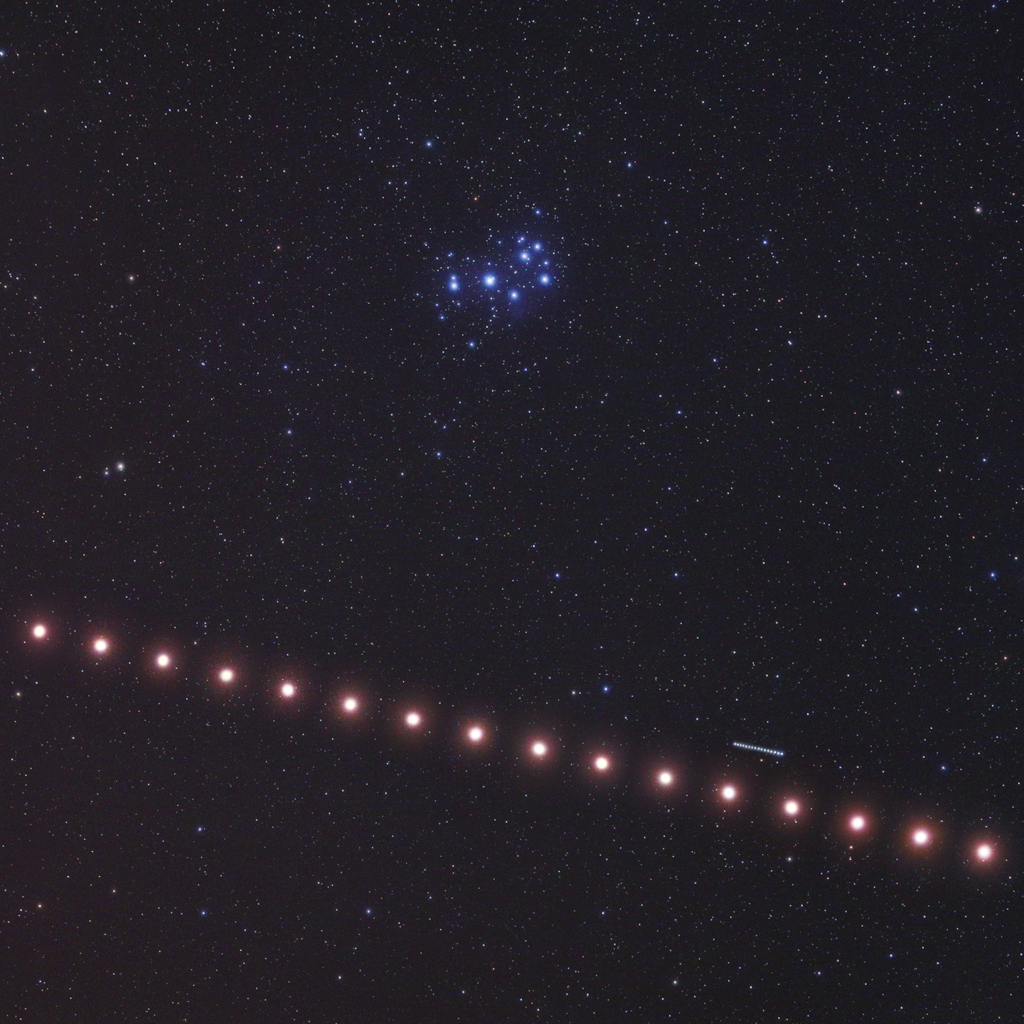
As Mars wanders through Earth's night, it passes about 5 degrees south of the Pleiades star cluster in this composite astrophoto. The skyview was constructed from a series of images captured over a run of 16 consecutive clear nights beginning on July 12. Mars' march across the field of view begins at the far right, the planet's ruddy hue showing a nice contrast with the blue Pleiades stars. Moving much faster across the sky against the distant stars, the fourth planet from the Sun easily passes seventh planet Uranus. Red planet Mars and the ice giant world were in close conjunction, about 1/2 degree apart, on July 16. Continuing its rapid eastward trek, Mars has now left the sister stars and outer planet behind though, passing north of red giant star Aldebaran. Mars will come within about 1/3 degree of Jupiter in planet Earth's sky on August 14.