Mars
Mars is the fourth planet from the Sun and the seventh largest in the Solar System. A cold, dusty desert world with a thin atmosphere (mostly CO₂), the planet features extinct volcanoes, deep canyons, polar ice caps, and seasons. Mars has two small moons (Phobos and Deimos), a day just over 24 hours long, and a year lasting about 687 Earth days. It is a prime focus of robotic exploration and studies about past water and habitability.
Source: science.nasa.gov
APODs including "Mars"
Late Night Vallentuna
15/08/2024
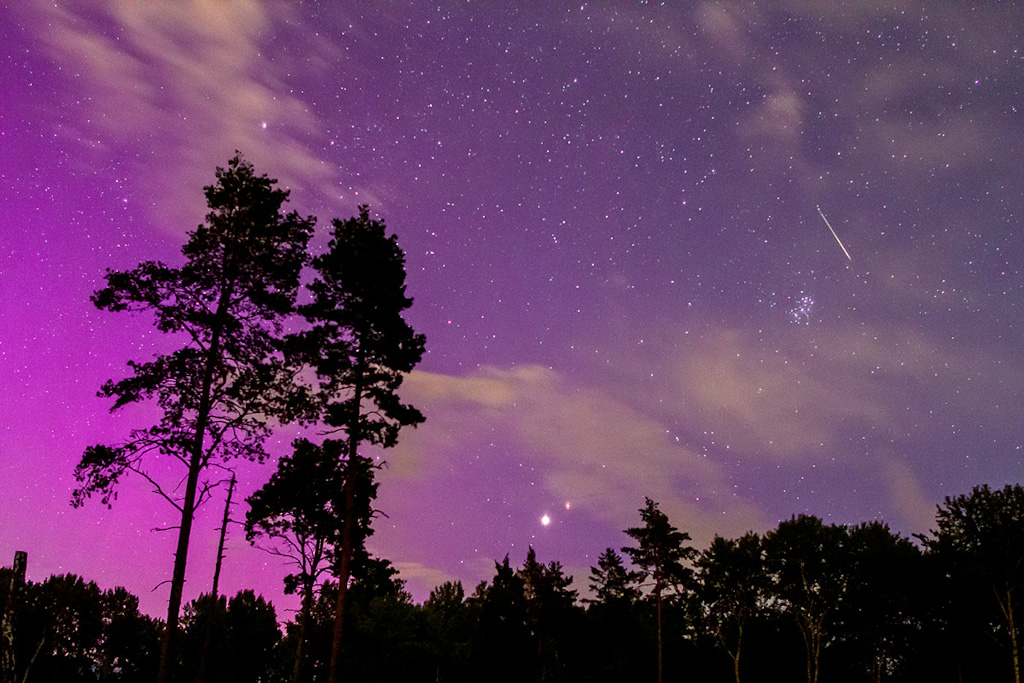
Bright Mars and even brighter Jupiter are in close conjunction just above the pine trees in this post-midnight skyscape from Vallentuna, Sweden. Taken on August 12 during a geomagnetic storm, the snapshot records the glow of aurora borealis or northern lights, beaming from the left side of the frame. Of course on that date Perseid meteors rained through planet Earth's skies, grains of dust from the shower's parent, periodic comet Swift-Tuttle. The meteor streak at the upper right is a Perseid plowing through the atmosphere at about 60 kilometers per second. Also well-known in Earth's night sky, the bright Pleiades star cluster shines below the Perseid meteor streak. In Greek myth, the Pleiades were seven daughters of the astronomical titan Atlas and sea-nymph Pleione. The Pleiades and their parents' names are given to the cluster's nine brightest stars. Gallery: Perseid Meteor Shower 2024 and Aurorae