Mars
Mars is the fourth planet from the Sun and the seventh largest in the Solar System. A cold, dusty desert world with a thin atmosphere (mostly CO₂), the planet features extinct volcanoes, deep canyons, polar ice caps, and seasons. Mars has two small moons (Phobos and Deimos), a day just over 24 hours long, and a year lasting about 687 Earth days. It is a prime focus of robotic exploration and studies about past water and habitability.
Source: science.nasa.gov
APODs including "Mars"
Mars: Moon, Craters, and Volcanos
09/09/2024
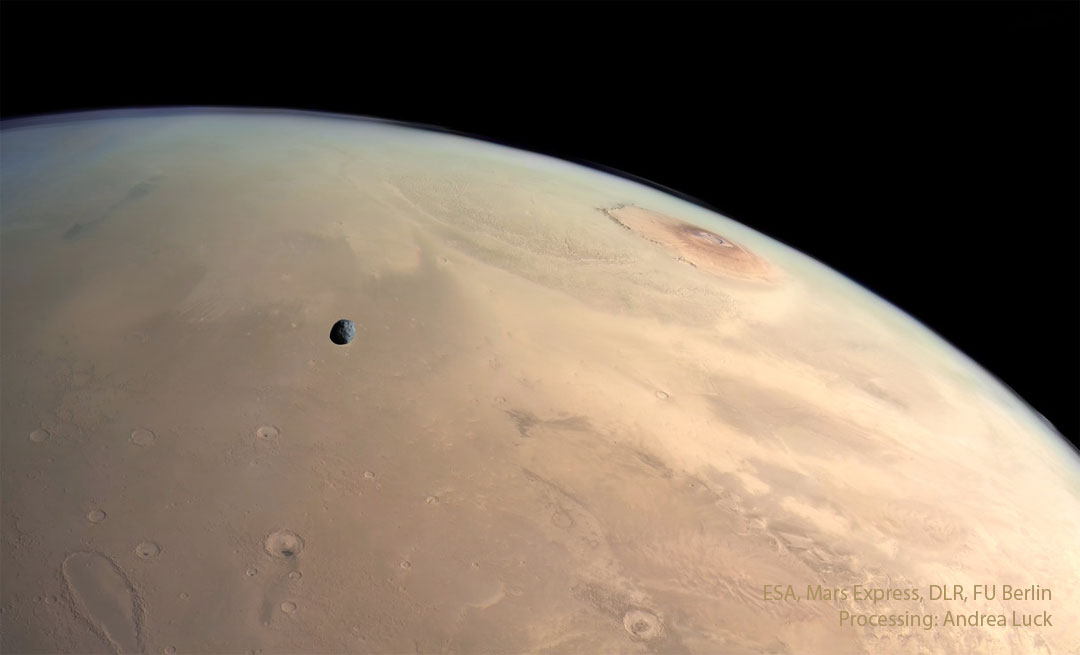
If you could fly over Mars, what might you see? The featured image shows exactly this in the form of a Mars Express vista captured over a particularly interesting region on Mars in July. The picture's most famous feature is Olympus Mons, the largest volcano in the Solar System, visible on the upper right. Another large Martian volcano is visible on the right horizon: Pavonis Mons. Several circular impact craters can be seen on the surface of the aptly named red planet. Impressively, this image was timed to capture the dark and doomed Martian moon Phobos, visible just left of center. The surface feature on the lower left, known as Orcus Patera, is unusual for its large size and oblong shape, and mysterious because the processes that created it still remain unknown. ESA's robotic Mars Express spacecraft was launched in 2003 and, among many notable science discoveries, bolstered evidence that Mars was once home to large bodies of water.