Mars
Mars is the fourth planet from the Sun and the seventh largest in the Solar System. A cold, dusty desert world with a thin atmosphere (mostly CO₂), the planet features extinct volcanoes, deep canyons, polar ice caps, and seasons. Mars has two small moons (Phobos and Deimos), a day just over 24 hours long, and a year lasting about 687 Earth days. It is a prime focus of robotic exploration and studies about past water and habitability.
Source: science.nasa.gov
APODs including "Mars"
Galle: Happy Face Crater on Mars
01/02/2026
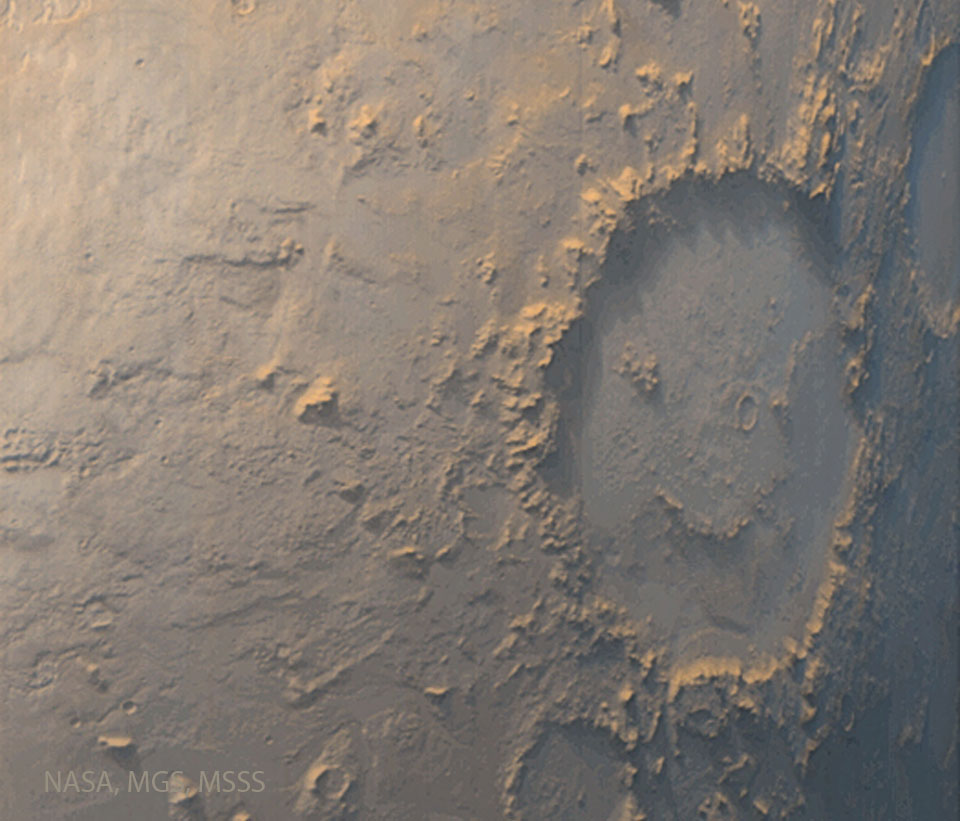
Mars has put on a happy face. The Martian crater Galle is famous because it has internal markings that make it look like a face that is both smiling and winking. These markings were originally discovered in the 1970s in pictures taken by the Viking Orbiter. The Mars Global Surveyor (MGS) spacecraft that orbited Mars from 1996 to 2006 captured the featured picture. Happy Face Crater and its iconic features were formed by chance billions of years ago when a city-sized asteroid slammed into the Martian surface. All rocky planets and moons in our Solar System show impact craters, with the highest number of craters found on Earth's Moon and the planet Mercury. Earth and Venus would show the most, though, were it not for weather and erosion. Sky Surprise: What picture did APOD feature on your birthday? (after 1995)