Image Credit:
Anglo-Australian Telescope
Board
Explanation:
Almost unknown to casual observers in the northern hemisphere,
the southern
sky contains two diffuse wonders known as the
Magellanic Clouds.
The Magellanic Clouds are small irregular
galaxies orbiting our
own larger Milky Way spiral galaxy.
The Small Magellanic Cloud
(SMC), pictured here,
is about 250,000 light years away and
contains a preponderance of young, hot, blue stars indicating it has
undergone a recent period of star formation.
There is evidence that the SMC is actually two
galaxies superposed to appear as one.
The bright blob near
the right hand edge of the frame is a
globular cluster near the
outskirts of the Milky Way.
Tomorrow's picture: GL 105C: The Coolest Star?
| Archive
| Glossary
| Education
| About APOD |
Astronomy Picture of the Day (APOD) is created and edited in 1995 by
Robert
Nemiroff (GMU) and
Jerry Bonnell (USRA). Specific rights may apply.
Correspondence about APOD should be addressed to
[email protected] or
[email protected].
A service of the
Laboratory for High Energy Astrophysics (LHEA) at
NASA/
GSFC
Technical Rep:
Sherri Calvo,
301-286-5668,
[email protected]
Questions/Comments/Feedback to:
[email protected]
General astronomy pointers are available.
/ NASA APOD
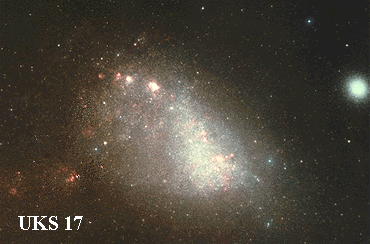
Almost unknown to casual observers in the northern hemisphere, the southern sky contains two diffuse wonders known as the Magellanic Clouds. The Magellanic Clouds are small irregular galaxies orbiting our own larger Milky Way spiral galaxy. The Small Magellanic Cloud (SMC), pictured here, is about 250,000 light years away and contains a preponderance of young, hot, blue stars indicating it has undergone a recent period of star formation. There is evidence that the SMC is actually two galaxies superposed to appear as one. The bright blob near the right hand edge of the frame is a globular cluster near the outskirts of the Milky Way.