Molecular Cloud
A dense and cold region of interstellar space composed primarily of molecular hydrogen, serving as the birthplace of stars. The molecular cloud associated with NGC 346 is actively forming new stars.
Source: science.nasa.gov
APODs including "Molecular Cloud"
Stars Forming in Serpens
31/08/2007
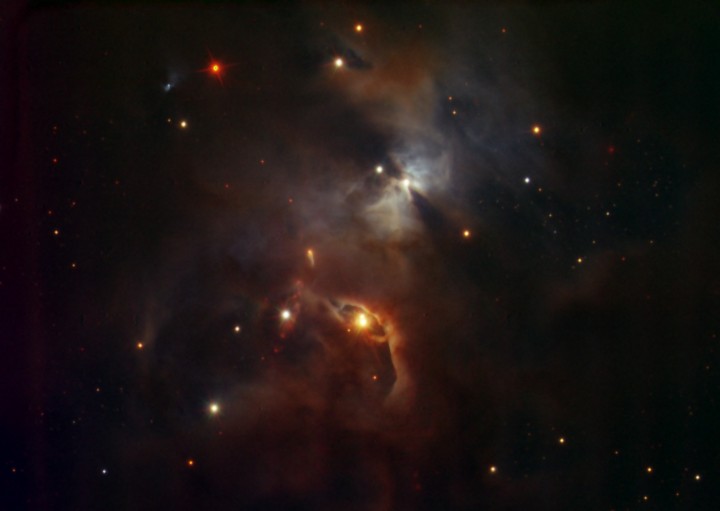
Stars are forming in a dense molecular cloud a mere 1,000 light-years away in the constellation Serpens Cauda (The Serpent's Tail). At that estimated distance, this sharp, near-infrared close-up of the active Serpens star-forming region spans about 2 arcminutes or just over half a light-year. Though such near-infrared observations can be made by mountain-top telescopes with specialized detectors, near-infrared light has too long a wavelength to be visible to the eye. This view was recorded with a sensitive camera, HAWK-I (High Acuity, Wide field K-band Imaging), just commissioned at the Paranal Observatory in Chile. Intended to illustrate HAWK-I's impressive capabilities, the tantalizing image highlights reddish young stars and protostars, likely up to a few million years old, emerging from the nebular gas and dust.