Molecular Cloud
A dense and cold region of interstellar space composed primarily of molecular hydrogen, serving as the birthplace of stars. The molecular cloud associated with NGC 346 is actively forming new stars.
Source: science.nasa.gov
APODs including "Molecular Cloud"
Thor's Helmet (NGC 2359) and Planetary Nebula
12/03/2009
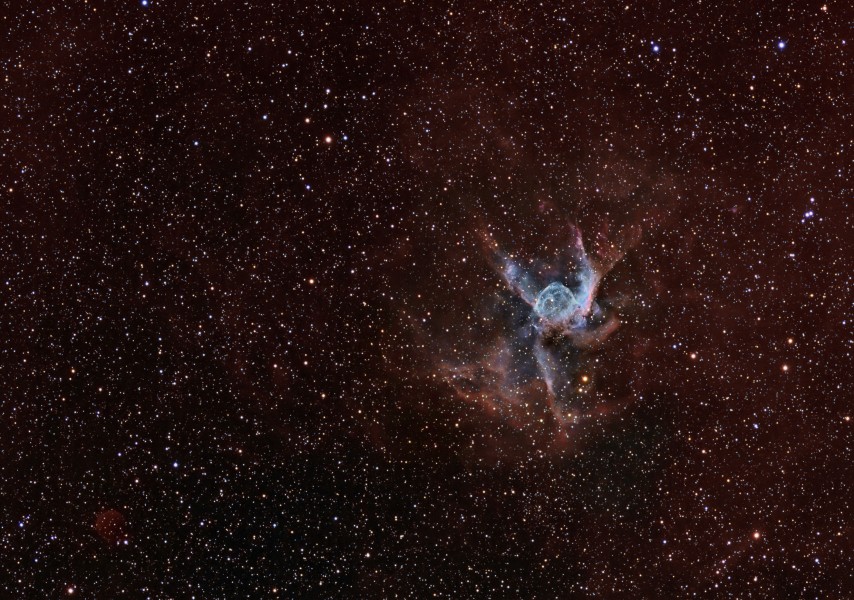
At the right, Thor's Helmet (NGC 2359) seems to gaze across a lovely star field. The broad skyscape itself covers about 1.5 degrees or 3 full moons toward the constellation Canis Major. A close look at the lower left corner of the image might identify the object of the cosmic stare as a faint, round nebula. Heroically sized even for a Norse god, Thor's Helmet is about 30 light-years across. The helmet is actually more like an interstellar bubble, blown as a fast wind from the bright, massive star near the bubble's center sweeps through a surrounding molecular cloud. Known as a Wolf-Rayet star, the central star is an extremely hot giant thought to be in a brief, pre- supernova stage of evolution. In contrast, the faint, round nebula is a planetary nebula, the gaseous shroud of a dying lower mass star. The distance to Thor's Helmet is estimated to be about 15,000 light-years.