Molecular Cloud
A dense and cold region of interstellar space composed primarily of molecular hydrogen, serving as the birthplace of stars. The molecular cloud associated with NGC 346 is actively forming new stars.
Source: science.nasa.gov
APODs including "Molecular Cloud"
Sh2-155: The Cave Nebula
19/10/2013
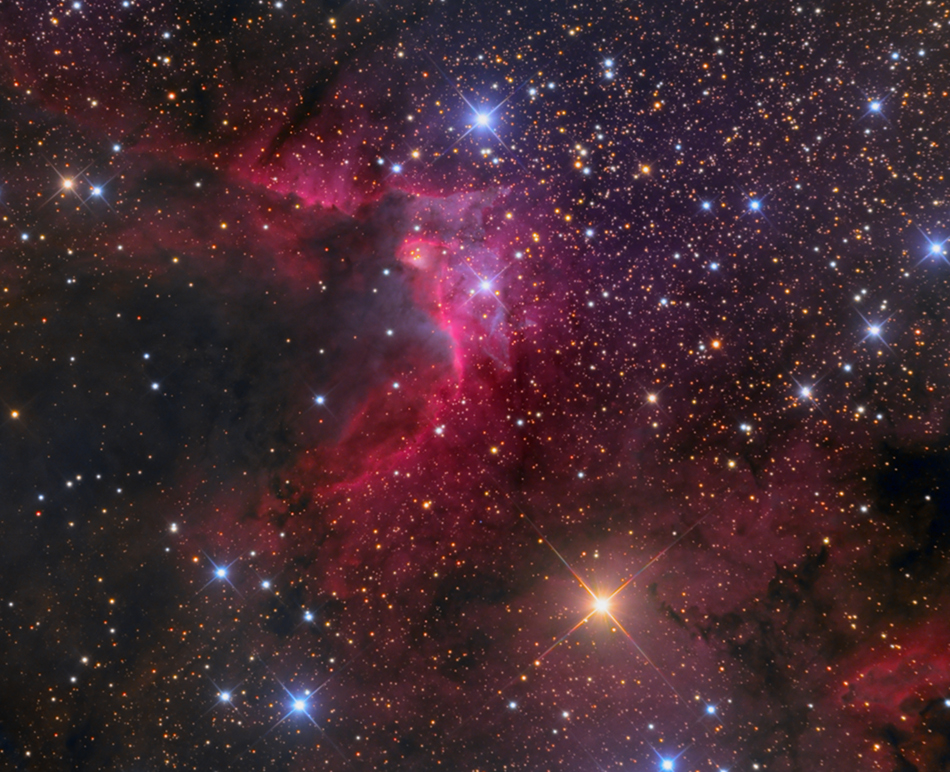
This colorful skyscape features the dusty, reddish glow of Sharpless catalog emission region Sh2-155, the Cave Nebula. About 2,400 light-years away, the scene lies along the plane of our Milky Way Galaxy toward the royal northern constellation of Cepheus. Astronomical explorations of the region reveal that it has formed at the boundary of the massive Cepheus B molecular cloud and the hot, young, blue stars of the Cepheus OB 3 association. The bright rim of ionized hydrogen gas is energized by the radiation from the hot stars, dominated by the bright blue O-type star above picture center. Radiation driven ionization fronts are likely triggering collapsing cores and new star formation within. Appropriately sized for a stellar nursery, the cosmic cave is over 10 light-years across.