Nebula
A nebula is a giant cloud of gas (mostly hydrogen and helium) and cosmic dust situated between stars in the interstellar medium. Nebulae serve as sites of stellar birth and death—including emission nebulae that glow from ionized gas, reflection nebulae that scatter starlight, and dark nebulae that obscure background stars.
Source: science.nasa.gov
APODs including "Nebula"
The Cat's Eye Nebula
28/06/1995
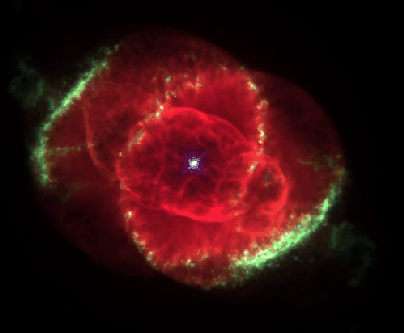
Today's Picture: June 28, 1995 The Cat's Eye Nebula Picture Credit: NASA, Hubble Space Telescope Explanation: Three thousand light years away, a dying star throws off shells of glowing gas. This Hubble Space Telescope image reveals "The Cat's Eye Nebula" to be one of the most complex "planetary nebulae" known. In fact, the features seen in this image are so complex that astronomers suspect the visible central star may actually be a double star system. The term planetary nebula, used to describe this general class of objects, is misleading. Although these objects may appear round and planet-like in small telescopes, high resolution images reveal them to be stars surrounded by cocoons of gas blown off in the late stages of evolution. Latest APOD Featuring this Image: July 4, 1996 For more information see NASA Space Telescope Scientific Institute press release. We keep an archive of previous Astronomy Pictures of the Day. Astronomy Picture of the Day is brought to you by Robert Nemiroff and Jerry Bonnell . Original material on this page is copyrighted to Robert J. Nemiroff and Jerry T. Bonnell.