Nebula
A nebula is a giant cloud of gas (mostly hydrogen and helium) and cosmic dust situated between stars in the interstellar medium. Nebulae serve as sites of stellar birth and death—including emission nebulae that glow from ionized gas, reflection nebulae that scatter starlight, and dark nebulae that obscure background stars.
Source: science.nasa.gov
APODs including "Nebula"
The Firework Nebula
04/07/1995
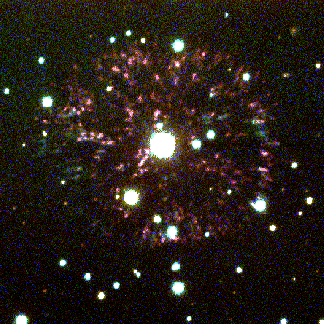
July 4, 1995 The Firework Nebula Picture Credit: WIYN Telescope Explanation: The Firework Nebula, known to astronomers as "GK Per", is the result of a type of stellar explosion called a nova. In a nova, a very compact star called a white dwarf blasts away gas that had accumulated on its surface. In this case the nova occurred in the year 1901 and is called Nova Persei 1901. This nova became as bright as one of the brighter stars we see in the night sky, but then faded until only a telescope could see it. Soon astronomers could see an expanding shell of gas that eventually became this spectacular nebula. The unusual "fireworks" type feature of this nebula is still a matter of research and discussion. For more information see the Wiyn Telescope press release. We keep an archive of Astronomy Pictures of the Day. Astronomy Picture of the Day is brought to you by Robert Nemiroff and Jerry Bonnell . Original material on this page is copyrighted to Robert J. Nemiroff and Jerry T. Bonnell.