Nebula
A nebula is a giant cloud of gas (mostly hydrogen and helium) and cosmic dust situated between stars in the interstellar medium. Nebulae serve as sites of stellar birth and death—including emission nebulae that glow from ionized gas, reflection nebulae that scatter starlight, and dark nebulae that obscure background stars.
Source: science.nasa.gov
APODs including "Nebula"
M1: The Crab Nebula
25/07/1995
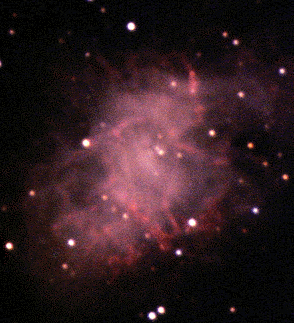
July 25, 1995 M1: The Crab Nebula Credit: The Electronic Universe Project Explanation: In the year 1054 a star in the constellation of Taurus exploded in a spectacular supernova so bright it appeared to dominate the sky except for the Sun and Moon for many days. It left behind one of the most brilliant nebulae, listed first in Charles Messier's list of nebulous sky objects. Today we know that the center of the nebula houses the remnant of the explosion: a spinning neutron star called a pulsar. The Crab pulsar is visible in almost every part of the electromagnetic spectrum, and has been a useful astronomical tool. It is still unclear how the the pulsar emits the light that we see. For more information on M1 see The Electronic Universe Project's write-up. Many images of Messier objects can be found in The Electronic Universe Project's The Galaxy Gallery: Messier Objects.