Nebula
A nebula is a giant cloud of gas (mostly hydrogen and helium) and cosmic dust situated between stars in the interstellar medium. Nebulae serve as sites of stellar birth and death—including emission nebulae that glow from ionized gas, reflection nebulae that scatter starlight, and dark nebulae that obscure background stars.
Source: science.nasa.gov
APODs including "Nebula"
Cometary Knots in the Helix Nebula
16/04/1996
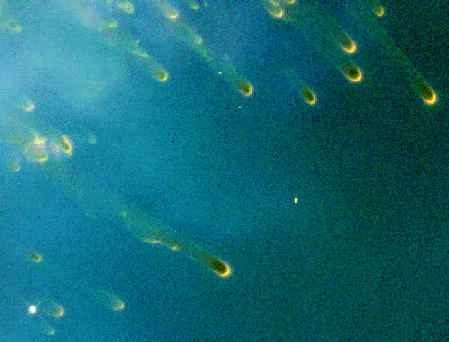
Four hundred fifty light-years from Earth, the wind from a dying, sun-like star produced a planetary nebula popularly known as the Helix. While exploring the Helix's gaseous envelope with the Hubble Space Telescope (HST), astronomers discovered indications of 1,000s of striking "cometary knots" like those shown above. So called because of their resemblence to comets, they are actually much larger - their heads are several billion miles across (roughly twice the size of the our solar system itself) while their tails, pointing radially away from the central star, stretch over 100 billion miles. Previously known from ground based observations, the sheer number of cometary knots found in this single nebula is astonishing. What caused them to form? Hot, fast moving shells of nebular gas overrunning cooler, denser, slower shells ejected by the star during an earlier expansion may produce these droplet-like condensations as the two shells intermix and fragment. An intriguing possibility is that instead of dissipating over time, these objects, could collapse and form pluto-like bodies. If so, these icy worlds created near the end of a star's life, would be numerous in our galaxy. Information: The Scale of the Universe Debate in April 1996