Nebula
A nebula is a giant cloud of gas (mostly hydrogen and helium) and cosmic dust situated between stars in the interstellar medium. Nebulae serve as sites of stellar birth and death—including emission nebulae that glow from ionized gas, reflection nebulae that scatter starlight, and dark nebulae that obscure background stars.
Source: science.nasa.gov
APODs including "Nebula"
Henize 70: A SuperBubble In The LMC
10/05/1996
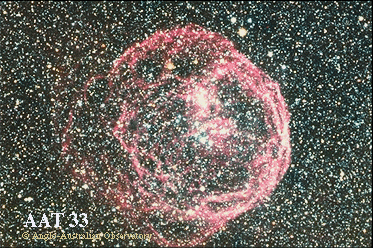
Massive stars (tens of times the mass of the Sun) profoundly affect their galactic environment. Churning and mixing the clouds of gas and dust between the stars, they leave their mark in the compositions and locations of future generations of stars and star systems. Dramatic evidence of this is beautifully illustrated in our neighboring galaxy, the Large Magellanic Cloud (LMC), by the lovely ring shaped nebula, Henize 70 (also known as N70 and DEM301). It is actually a luminous "superbubble" of interstellar gas about 300 lightyears in diameter, blown by winds from hot, massive stars and supernova explosions, its interior filled with tenuous hot expanding gas. These superbubbles offer astronomers a chance to explore this crucial connection between the lifecycles of stars and the evolution of galaxies.