Nebula
A nebula is a giant cloud of gas (mostly hydrogen and helium) and cosmic dust situated between stars in the interstellar medium. Nebulae serve as sites of stellar birth and death—including emission nebulae that glow from ionized gas, reflection nebulae that scatter starlight, and dark nebulae that obscure background stars.
Source: science.nasa.gov
APODs including "Nebula"
The Blue Snowball Planetary Nebula Credit:
21/11/1996
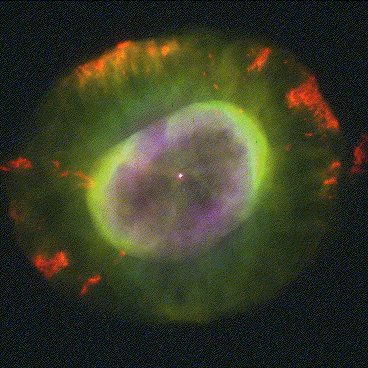
Will the Sun one day look like - a blue snowball? Maybe! The Blue Snowball is a planetary nebula - and in 5 billion years the Sun will throw off its outer layers and go through a planetary nebula phase. A star can appear "normal" only so long as there are sufficient nuclear reactions in its core. Soon thereafter, gravity will win out and compress the stellar core to higher temperatures. Eventually the core becomes a white dwarf. These high temperatures somehow cause the expulsion of star's outer layers, creating a planetary nebula such as the Blue Snowball pictured above. Although the Blue Snowball, also known as NGC 7662, does appear blue, the above picture's colors are not real and were chosen to highlight the emission of certain ions in the nebula. Many things are still not known about planetary nebula, including details of the physical mechanism that creates the nebula, and the reason for fast knots of gas in the outer regions known as fliers.